Showing posts sorted by relevance for query helicopter mama. Sort by date Show all posts

5.31.2019

helicopter mama

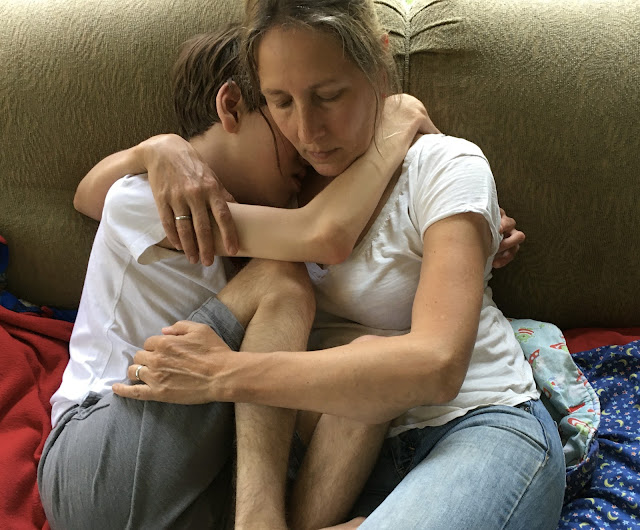
I'm a helicopter mama, hovering over the natural disaster that is my non-verbal, incontinent, legally blind, autistic, cognitively and physically disabled, chronically ill son. Regular electric storms wreak havoc inside his skull causing him to writhe, twitch and convulse. Including this morning's, he's had nine grand mals this month. A recent electroencephalogram revealed brief, fifth-of-a-second epileptic discharges (not considered bona fide seizures) occurring—at their most frequent, during sleep—once or twice every ten seconds or so.

I'm a helicopter mama for which I sincerely apologize to no one. I know my son far better than anyone. He's on my radar all day and all night long—no further than arm's reach, mind's eye or earshot. I know when he is too warm, too cold, when he's having, just had, or needs a poop, even if he's not in the room. I know when he's apt to wet through, when he's hurting, feverish or seizing, mostly when others don't. On days when he's most vulnerable—in the wake of or lead-up to seizures—I know when a bath is likely too long or cool, or a walk in the sun with wind is too cold. Exposure to the elements can sometimes be stressful for kids like him. Because Calvin can't speak, I've had to become adept at walking in his shoes. I know when he's headed for a seizure hours before it occurs, can sense its omen's and feel in my gut the weight of possible triggers. And yet I find myself biting my lip, reluctant, though failing, to hover too much over others caring for him. Though I don't want to be, I'm good at stepping on toes.

Some say, you have to trust us. I respond, trust is something to be earned. Others say, I love your boy, then go on to verily neglect my son.

As other helicopter mamas of kids like mine will confirm, some folks—whether with empathy, ignorance, conceit, contempt or concern—make attempts to save us. We are told to relax, told not to worry, asked if we are tired (hahahaha!) and told to get some rest. We are told not to get upset in front of our kids lest our outward stress set off a fit. This unsought advice, though likely sincere but perhaps—even if subconsciously—self-serving, brings to mind a favorite quote from a song by Gang of Four:

Save me from the people who would save me from myself.

The rest of the lyric, which is deliciously irreverent and hilarious, but which I rarely quote because it it is also rude, goes:

They've got muscles for brains.*

Something helicopter mamas also hear often is, Everything will be fine.

One dear friend genuinely put it this way:

Calvin is not going to die (anytime soon) ... or maybe he will.

She did not sugarcoat. She did not dismiss. She spoke what I know to be the truth, which in a strange way gave me a sense of calm, knowing in that not-too-unlikely, worst-case scenario I'd have done everything humanly possible to keep Calvin safe. As a helicopter mama, I'd have done my very best.

*Yesterday I took this line out for fear it offended, but then I added it back in for full transparency and accountability, noting what I hadn't originally, which is that it is rude.

Photo by Michael Kolster

6.02.2019

bigger picture

My husband said, "You have to forget yourself." He was describing what it takes to care for our son. It's a monotonous, tedious, sometimes frustrating job which requires laser focus on Calvin's every move lest he get hurt or make a mess out of things, namely his own shit, of which I have much first-hand experience.

In yesterday's post, helicopter mama, I describe some of the minutiae of Calvin's care, my bad habit of hovering over him and his caregivers and, in doing so, my tendency to step on toes. The post drew a number of comments, the first from my friend, Les, whom I've known for twenty-three years. He wrote:


You are the only woman I know that is strong enough and has the right personality to do what you do.


One of Calvin's former therapists commented:


poignant and insightful for those who hope to say the right thing ... but don't.


A friend and mother of a child like Calvin sent me one of two heart GIFs, and another simply said:


Yup.


One reader with whom my post struck a nerve, wondered for whose benefit I write the blog. I explained that I write it 
for myself and those in similar situations, with the added hope of engendering introspection, including in myself, and to offer insights into messy situations which are nearly impossible for most people to imagine or grasp otherwise. I said I hope the blog prompts readers to put themselves in other's shoes, to recognize their own good fortunes and perhaps inspire empathy, humility and gratitude. I should have added that I aim to reach people who find themselves in any kind of stressful, challenging circumstance, hoping they find solace in my words and perhaps feel less alone.

Another reader, a poet whom I've never met, sent me a personal email in which she said:


I hope most caregivers have grace and understand and allow room for what you need to do to be with your son. Caregivers have a difficult job too—but it is not the same thing as being you in your relationship to Calvin. True healers one hopes for—and the healing is in support of you too. It has to be. You and Calvin are not in isolation from each other, and I (can only) imagine this requires dedicated teamwork. 

She went on to say:


I have been reading your posts for a number of years now—I don’t know how many years. Your honesty about yourself and others—not sham “honesty” to excuse cruelty, but true and difficult honesty—is your integrity. You don’t make this shit up. You hold yourself accountable. I hope most of your nurses and other supporters understand and can be there with you.

Her words brought me to tears; I sincerely hope I live up to them.


While I digested the various comments yesterday, one in particular, I realized that my post was missing something. I needed to helicopter out to see the bigger picture rather than hovering at microscopically close range. I'm not saying caregivers shouldn't forget themselves and focus closely on the job at hand: my boy's safety and well-being. I'm saying that from a more generous vantage point I'm able to see that, for all of my complaining and frustration, most of our many caregivers over the years—nurses, ed techs, teachers, therapists—have been lifesavers of sorts. If it weren't for their assistance, their affording me much needed respite, who knows how I'd be dealing? And I'm not saying I couldn't take care of Calvin without them. I know I could. I did for the first two years of his life and for months at a time since then. But I've little doubt I'd be in far worse shape without having had them, (not that I'm in that good of shape now.) Caregivers have allowed me to walk the dog, romp in the garden, write my blog, research epilepsy treatments, do house chores and shopping, catch a rare movie and sometimes a much-needed nap, and grab a drink and a bite with my husband. But perhaps the most important thing of all that has nothing to do with me is that they have always doted on my son.

As I finish this post—one not unlike most others in which I begin writing without fully knowing where it will end up—I see that it has done what I hope my posts do. It has prompted (my) introspection. It has humbled me some, revealing my thin skin and pettiness. And it has helped me to be grateful for my own good fortunes.


Calvin and nurse Rita

9.20.2019

empathy and betterment

Though the grass is green, this dry spell has the shrubs curled up and thirsty. In their withering, I see myself, stressed and brittle. This journey as the mother of a child like Calvin—a teen who is legally blind, incontinent, nonverbal, physically and cognitively impaired, beaten by seizures and the drugs meant to thwart them—is a hard one both physically and emotionally. I'm chronically sleep deprived, burdened with worry, at times gripped by fear, anxiety and the shadow of devastation and despair. I wish I could somehow flee this reality. My mind is constantly buzzing with dour, unanswerable questions:

when will Calvin's next seizure be? will he choke on a piece of food? will he trip over a chair, run into a wall, fall down the stairs? do his bones ache from growing so fast? will he ever be able to tell us yes and no? will his various caregivers love him, keep him safe from harm? will he get good therapy at school? will he suffer another pain episode? will he ever be calm again? will he outgrow his seizures? will he die from one?

It appears that these burdens and worries most people don't fully understand. I see evidence in the scowls and puzzlement of strangers, in the way some folks avert their eyes when passing us, in the ways we have been dismissed or patronized by smug doctors, hospital nurses, and a handful of school employees over the years. I've little doubt that in my assertive, hypervigilant, helicopter mama-ness, I have haters and eye-rollers. There are those who don't take me seriously, think I'm oversensitive, inflexible, overbearing, unhinged. There are those who run when they see me coming, or who regularly assume the conspicuous and irksome cover-your-ass posture and pose. I wish all of them could walk in my shoes.

As is true with most of this nation's disenfranchised, misunderstood communities—the Disabled, People of Color, LGBTQI people, Muslims, asylum seekers, immigrants—Calvin and I are sometimes regarded with caution, mistrust and fearfulness, even perhaps contempt. I attribute this mistreatment to ignorance and a resulting empathy gap, an inability by some to more fully understand the struggles those on the margins of majority straight-White-Christian-able-bodied society endure, though all it really takes is openness and humility, to listen well and put oneself in other's shoes. But perhaps it's easier to avoid doing that, to stop short of admitting privilege, and less upsetting to avoid acknowledging ugly truths. But denial and indifference to the hardships of others gets us nowhere—as individuals, as communities, as a nation—on the path to betterment.

Wednesday morning, over coffee and a tasty blueberry scone at our favorite Dog Bar Jim cafe, a friend and I discussed the wave of asylum seekers from Angola and The Democratic Republic of the Congo whom our town has recently aided and absorbed. She recounted a conversation she'd had about the African soccer players who have joined the high school team, some who are quite good. Apparently, some parents are bemoaning the amount of playtime the asylum-seekers are getting (I can't help but wonder if their reaction would be different if the students were from Italy or England). When my friend's own soccer-playing son questioned it, she offered him an analogy: if he were to transfer to a new school with weaker players, he might get lots of playtime, too. A thoughtful kid, he understood.

My friend and I went on to discuss how helping asylum seekers is not the zero-sum game some purport is true. For example, we can also help our homeless neighbors and veterans, and we do. Furthermore, asylum seekers, once they're cleared to work, often fill the grueling, dangerous, tedious jobs many Americans don't want—harvesting crops, packing meat, caring for the elderly in nursing homes. My friend told me of a refugee physician who is driving a taxi just to make ends meet.

After our coffee date, I imagined the asylum seekers playing soccer with my friends' kids—one of a million things my son will never be able to do. Some of them speak four or five languages, having picked up Spanish and English on their journey north from Brazil. Many, if not most, traveled thousands of miles through South and Central America having escaped life-threatening circumstances back home. On their trek they survived beatings, muggings, hunger, thirst, and five months of travel on foot, at times through dense forests dark as night, stepping over the dead bodies of other refugees who would not make it to the USA. The ones who made it here are strong, tenacious survivors who likely have what it takes to make the best Americans. And yet, because of fearmongering and ignorance, they are sometimes met with animus and contempt, perhaps even envy and hatred. With this thought I imagine Calvin and the folks who seem to see him—without understanding his purity, love and struggle—as a freak, aversion or contagion.

I wonder what would happen if asylum seekers had the chance to tell their stories. Who would listen? Who would understand? Will these refugees, like Calvin, inspire some of us to become better people, better members of society? Will some of them give rise to other, better soccer players? Who, upon hearing their stories, would feel empathy and embrace them? And who would stand their ground, unmoved?

Carolyn Cole / Los Angeles Times

7.16.2019

questions (some rhetorical, others not)

will these early-morning seizures ever stop? will calvin eventually succumb to them? am i slowly going crazy? is my son already insane? when will so much of white america finally confront their ugly racism and bigotry? do i have traumatic stress disorder? has being a helicopter mama ruined me? will my patience ever give way? how can i stand my angry self? will life with calvin ever get better? why did that guy sitting on his porch look away from us when i caught his gaze? will folks ever stop gawking at calvin and me? will my son ever learn how to feed himself? will he ever be potty trained? will he ever be seizure free? when might i get a full night's sleep? am i being selfish? how do i manage living with my son's chronic illness and disability? when will police ever stop mounting violence against black and brown people? will contempt for the poor ever fade? will the occupant of the oval office ever be dead to america? when will women be treated equally? what will happen to the children of refugees? how can so-called leaders seem so unmoved by their caging of humanity? why are some folks so ignorant, cowardly and afraid of change? will calvin live beyond our years? will he die next week? next month? next year? how can i keep caring for him? could i really let someone else be his caregiver? will others prey on him? have they already? why do i feel such love and the next minute such contempt? will i ever get my life back? is this my life? what would life be like without him? will i ever return to rome? paris? madrid? will we ever leave maine? why do some folks believe in a merciful god amid such vast injustice and misery?


Photo by Michael Kolster

2.17.2022

can't help myself

Tuesday night at seven, while Michael and I were eating dinner, I heard Calvin yelp. He was seizing. Michael and I ran upstairs, unlatched Calvin's safety netting and bed panel and scooted him toward us so his feet wouldn't strike the bed's wooden edge. When it was over, we dimmed the lights and ate the rest of our dinner, plates in our laps, while sitting vigil as Calvin tried to catch his breath before drifting back to sleep. It had been ten days since his last couple of fits.

I'm not one to shy away from a challenge, but if I knew how hard this mothering thing could be, I'm not sure I'd have signed up. While raising Calvin, I've experienced joy, pride, and immeasurable love, but too often it really sucks. Parenting him has meant sacrificing—almost entirely—opportunity, dreams, travel, leisure, freedom, a good night's sleep. Many parents might share these sentiments. But what I thought of as the promises and joys of parenthood (you know what they are, and I've written about them ad nauseam) have been replaced by a lot of grief and anguish. Since Calvin's birth, I've watched him endure more suffering than any little brain and body should—an excruciating and unnecessary intubation, painful IVs, blood draws and surgeries, digestive distress, relentless seizures including a horrifying one that lasted forty-five minutes, vicious drug side effects, agonizing withdrawal. I've seen days upon weeks upon months upon years of what I think might be nausea, migraines, tinnitis, cramps, akatheisa (acute and chronic restlessness), panic, and perhaps even psychosis. Nearly every day—whether for moments or hours—he doesn't seem to feel very good.

While many of us, including me, learn to live with the hardships of life, in some ways adjusting, I'm not sure that is true for Calvin; it appears, judging by his frequent moaning, shrieking, head-rubbing, eye-poking and howling, that his miseries persist. It's hard to imagine feeling bad so often. What kind of life is that for any child to live? Witnessing it nearly kills me (and doesn't make me stronger.)

In mothering my legally blind, nonverbal, uncoordinated, incontinent, autistic, seizure-riddled son, I've become a hypervigilant helicopter mama, and I haven't managed to find any way around it. My son's afflictions require I be on guard at all times to limit his risk for trips and falls and broken bones, choking, drowning in the bath, epileptic fits. I'm laser-focused on trying to lessen his misery—from headaches, tummy aches, toothaches, anxiety, hunger, thirst, restlessness, constipation, discomfort, and cold. It's my job. If you think that's an impossible feat with a kid who can't express in words, signs or gestures what is troubling him, you're right. I can only do my best to constantly anticipate, observe and analyze. I must rely on logic, common sense, and instinct. How else can one care for a kid who is such an enigma? My brain is working on treatments, preventions and solutions for any given situation pretty much around the clock. I even dream about this shit, both literally and figuratively.

Reasonably, or so I believe, I ask and expect similar vigilance in others who take care of my son. Regrettably, however, my hypervigilance seems to lead me to micromanage. Though I don't mean to, I can come off as critical, which is sometimes met with defensiveness. I get it. Though my intentions are good and I try to be kind, I'm perhaps not the best messenger for my own messages, in part maybe due to my assertiveness and candor which—for whatever reason(s)—are often not appreciated, valued or understood. To make matters worse, in my hypervigilance I often vacillate, communicate too much information or not enough, causing others to second-guess for fear of making a mistake. They tell me they don't know what I want. Self-deprecatingly, I tell them no one does. Half the time I'm not even sure if what I recommend for Calvin is right; I often question myself. Just as the book What To Expect When You're Expecting proved utterly useless to me during and just after my pregnancy, there's no handbook for taking care of a kid like mine.

But one thing is for certain. There is a method to my madness: to keep my son as happy and feeling good as possible despite his circumstance. And in that way, perhaps it's a blessing and not a curse that I just can't help myself.

Photo by Michael Kolster