Showing posts with label loss. Show all posts

12.02.2022

back in time

"Do you love me?" I ask from the far side of the butcher block, a question to which I know the answer, but which I ask periodically, just to be humored.

"Yes. More than anything in the world," he replies, as he looks at me with intent.

A bit incredulously, I follow with, "Even Calvin?"

"Yes," my husband answers, "but he's catching up."

The expression I give lets him know I wonder what he means.

"He's becoming more lovable," he says.

"Like when he was a baby," I add, "when he was feeling good ... he was all happy and lovable. It's the drugs that have fucked him up."

After a pause, I go on to say:

"Some doctors are assholes," thinking about the bad ones—the one who needlessly prescribed Calvin's first benzodiazepine and the ones who prescribed extremely high doses of too many drugs—sometimes several at once—that didn't work and that fucked him up, caused him to be and remain so impossibly restless.

Michael nods his head.

"I wish we could go back in time." I say, wishing I knew—and could have employed—then what I know now.

But I can only go there in my memories and dreams.

One-year-old Calvin, March, 2005

10.03.2022

blind luck

The sound Calvin makes when he has a grand mal seizure is no sound a parent wants to hear coming from their child, nor anyone for that matter. It's blood-curdling. Sometimes it's strident, a bit like a barking dog or seal, and at others it sounds like someone being murdered. The screech that ripped me out of sleep Wednesday morning was doubly loud, long and alarming for some reason. To add insult to injury, it came on the heels of last Monday morning's grand mal.

It's a sinking feeling watching your child seize, especially when there's really not much to do save administering emergency medications, which have their own slew of troubling side effects, though luckily aren't usually necessary for Calvin since for years his seizures have stopped on their own. The clusters, however, are harder to control.

And so, to avoid subsequent seizures, when the seizure was over I incrementally syringed two milliliters of my homemade THCA cannabis oil into the pocket of Calvin's cheek and watched him drift back to sleep. Then, to monitor his breathing, I crawled in next to him—head to toe now that he's bigger—held his little foot in my hand, and my brain went to work on the days' events.

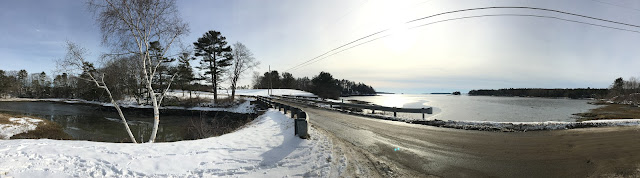
I thought about how last Tuesday authorities found the body of fourteen-year-old Theo Ferrara, the boy who went missing in the next town over nearly two weeks ago, and about whom I mentioned in my last post. His body was found in the waters of Maquoit Bay near Bunganuc Point not far from where I drive with frequency, and just downstream from where I took this photo.

Considering the lightweight clothing Theo had been wearing when he was last seen—a windbreaker, t-shirt, shorts and flip-flops—the chilly nights dipping into the forties had added to my worry. Since his disappearance, I'd been going to bed thinking of him and hoping he'd turn up safe and sound somewhere. The news is tragic, and authorities won't know the circumstances of his death for weeks.

To aggravate the tragedy of Theo's death, on social media earlier last week parents were posting pictures of their children in celebration of National Daughters and Sons days. While I love, am grateful for, and am proud of my sweet boy Calvin, the feelings the photographs evoked are bittersweet because too many of my friends' precious children—Lily, Rose, Rainier, Jennifer, Will, Tyler, August, Kelli, Martin, Mikki, Mike, Kevin, Ronan, Charlotte, Arnd, Michael, Elisif, Melissa, Matt, Cyndimae, Katie, Christina Taylor, Finnegan—left this earth far too soon. Still others may have tried to have had children but couldn't.

And so, as I lavish attention on my own child, and despite Calvin's challenges and afflictions which send me reeling and into dark places, I try not to forget our blind luck. I try to hold in my heart others who have suffered the greatest loss any parent could know. And, in moments when I complain and feel deeply the frustrations of raising my enigmatic, impossible child, I'll try my best to hold him a little more often, a little closer, and a little longer than when otherwise I might be apt to ignore.

9.26.2022

lost boys

I was going to write about why I haven't been writing much (instead, busy with running, some autumn gardening, taking care of a recently-sick Calvin, and doing online modules to complete my DSP (direct support provider) "training" so that I can begin being paid a little for taking care of Calvin. I was going to write about the fact that, on a moderate dose (100 mgs) of Calvin's newest drug, Xcopri (cenobamate), he's been going longer between seizures (thus having fewer), and that he didn't have a fever or a febrile seizure after last Friday's Covid booster. I was going to mention that he hasn't had any focal seizures since February, and that, overall, his behavior is better.

I was going to write about our near-perfect trip to the Cumberland County Fair yesterday where, under hazy, lavender-ish skies, Calvin did some amazing, albeit brief, stints walking by himself (too good to be true? we wondered aloud) down and back through a barn of draft horses and even a bit further. I was going to write about how straight and stable he sat at a red picnic table drinking from his sippy cup, that he enjoyed bites of warm, cinnamon-sugar donut, that all day long he signed "eat" very well, putting his finger to his mouth when he wanted more.

But, halfway through our time at the fair, when the crowds began to gather choking the pathways, and the midway rides ignited their noisy motors, and the hot sun began to filter through a bit too strong, Calvin's relative well-being seemed to go south. His intermittent walking deteriorated, so we put him back into his stroller. His skin felt hot. His face went pale. He began to perseverate, elbows crooked and waving, knitting his fingers. On the drive home, he batted and grabbed for me incessantly as if to be saved from something.

Then last night came the perfect storm—the new moon, a drop in the barometric pressure, perhaps a semi-latent affect from Friday's Covid booster, the sky opening up to unleash one of the hardest downpours I've heard since moving here—and at 2:45 this morning, Calvin had a grand mal seizure. It had been fifteen days since the last one. This time, when the fit was over, I gave Calvin twice as much of my homemade THCA cannabis oil as I usually do, hoping to prevent a second one from striking like they often do. Thankfully, it seemed to work.

As I laid in bed next to my boy in the pitch black of his room, I thought about the day's events and the looks Calvin got from strangers—some kind, others curious or suspicious, perhaps even put-off. I thought about the rides I would've liked to have taken him on, the animals I wish I knew if he saw and wish he could enjoy petting, the contests I wish he could've entered if he wanted to, the fact that, in ways, Michael and I wish we could've been at the fair without him.

As Calvin slept, at times arching, I thought about our ride home through parts of Freeport, Maine, where good neighbors and authorities were and are actively searching for a skinny fourteen-year-old boy named Theo who went missing four days ago wearing shorts and flip flops as nights dip into the forties and fifties. I wondered what happened to him. Was he snatched up by a nefarious actor? Did he fall into a hole or into frigid waters? Was he bullied into a state of anxiety, depression or some sort of submission? Did he end his own life? Was he trying to escape something or someone?

Then, I thought about the bluegrass concert given at my friends' gorgeous farm last Friday night in memory of their young and precious son, Finnegan, who died in a kayaking accident last November. So many amazing and loving people gathered together to make food, music, and memories in honor of a beautiful boy—at nearly 24, a young man, really—who was lost far too soon. I felt grateful to have been able to be there, at least long enough to give and get some hugs, to visit with beloveds a bit, and to remember my young friend, Finnegan, for the incredible human being he was.

In thinking about Theo and Finnegan, I considered the grief I feel over my own lost boy. I often wonder what would have become of Calvin—or what he would have become—if he hadn't been born missing most of the white matter in his brain. I mourn the loss of a boy who is flesh and blood sitting right in front of me—the loss of his artistic, athletic, academic, physical, philosophical, humanitarian potential. The loss of seeing him make friends and meet new people, and of us becoming their close friends, too. The loss of seeing him fall in love. The loss of the potential of having a growing relationship with our adult child. The loss of possibly having a grandchild or two to dote on.

Then, I think about my blog and memoir in progress and how I'd never have started writing them if not for my boy. Perhaps I wouldn't be quite so charmed by gardening if I didn't feel the need to shape nature since I can't control my son's regrettable disabilities and miserable afflictions. Maybe I'd never have started running (again) if not for need of an escape from a hard and restricted life of mothering an impossible infant-toddler-teen. Maybe I'd never have embarked on my pandemic back roads travels, which have bore new friendships, sparked a love for taking copious panoramic photographs, caused me to reflect so deeply on life and the mundane. These amazing endeavors I'd likely never have chanced upon if not for Calvin.

And though it's no consolation, my lost boy and what he has brought to me and to others is so worthwhile, and worth pondering. 

7.30.2022

to love life

We sat in the closeness of the sticky mid-morning heat, our bare arms and thighs touching. The rickety bench Woody gave me, one that dropped another screw recently, held us even as it swayed under our weight. I wrapped my hand around hers and kissed her cheek. We drank little rivers—she a sparkling citrus-scented water from a can, and I tap water held in a heavy green glass. We listened to a goldfinch sing as the wind swept through the trees. It felt as if we were the only ones in the world, and tears of sorrow came to us both as we contemplated life's tragedies.

During our walk earlier, she and I talked of mosquito bites, politics, running races, friendships, gardens, daughters, sons. Something flew up the open leg of her shorts and stung her repeatedly. I peeked into the back of her waistband and a bee—or was it a wasp?—flew out. She bent and plucked flat leaves of plantain, put them in her mouth, chewed them into a mash and applied tiny wads to the stings as a medicinal salve meant to draw the poison out.

"Everything we need is here for us," she said, meaning that nature is the original balm, then adding that we've just forgotten how to use it. I thought of Calvin's cannabis oil and how well it seems to help quell at least some of his seizures.

On our walk home, we stopped to cut—with permission—bunches of nodding sunflowers from our friends' backyard. Some of the smaller ones, which were still closed tightly like little fists as if reluctant to open to today's world, reminded me of my newly-born, four-pound, six-week preemie's apple-sized head and cinched brow. What a difficult yet extraordinary road it has been since then.

Later, when early evening came around and as I washed up dishes listening to my Calvin moan and rustle in his bed upstairs, I was again on the verge of weeping. My son is so often out of sorts or miserable, suffering from one thing or another inevitably brought on by seizures and/or their drug treatment. Though it had only been five days since his last grand mal, I could sense one coming by his bad balance, stubbornness, intensity, neediness, sour breath, eye poking, fingers in his mouth and mine, the new moon on the rise. I thought again about my earlier conversation with my friend. While strolling along a wooded path we had discussed abortion and the recent Supreme Court's abysmal decision to reverse Roe. I told her that, had I known for certain early on in my pregnancy that Calvin would be born missing most of the white matter in his brain which would cause him to be legally blind, uncoordinated, nonverbal, incontinent, cognitively impaired and—worst of all—be pummeled by thousands of uncontrollable seizures, I might have chosen to end the pregnancy to spare his suffering. To say that life for him is limited and presents major daily challenges, pain and miseries would be a gross understatement. Lamentably, there is so very little that Calvin seems to enjoy, mostly because he's been ruined by the drugs which cause him, at the very least, to be impossibly restless, making it harder, too, for me to live the life I want to live.

Just before my husband arrived home for the evening, I sat near the open French doors which look out onto the garden. There, while I reflected on my day and wrote this post, I came across this poem by Ellen Bass:

The Thing Is

to love life, to love it even
when you have no stomach for it
and everything you’ve held dear
crumbles like burnt paper in your hands,
your throat filled with the silt of it.
When grief sits with you, its tropical heat
thickening the air, heavy as water
more fit for gills than lungs;
when grief weights you down like your own flesh
only more of it, an obesity of grief,
you think, How can a body withstand this?
Then you hold life like a face
between your palms, a plain face,
no charming smile, no violet eyes,
and you say, yes, I will take you
I will love you, again.

    It struck me that I'd come across a poem so fitting for me, for my life with Calvin, and for the day I had just lived. 
    
    Just as Michael and I were sitting down for another sublime dinner in the screen porch, I heard Calvin make a strange noise. In that instant, I thought again about grief—ours, his, my friend's, everyone's—as I bounded up the stairs to find my sweet, pure, innocent beloved son—the boy who rocks my world in the most terrible, lovely, heavy (an obesity of grief) and amazing ways—as he was seizing again. I stroked his thigh and Michael embraced him and kissed his face. We've done the same perhaps thousands of times before and will very likely do the same a thousand times more, because Calvin is our precious son, and because it is our life, and in most ways we love it, and what else is there?
 

1.27.2022

helplessly hoping

Helplessly hoping
Her harlequin hovers nearby
Awaiting a word
Gasping at glimpses
Of gentle true spirit
He runs, wishing he could fly
Only to trip at the sound of good-bye
Wordlessly watching
He waits by the window
And wonders
At the empty place inside
Heartlessly helping himself to her bad dreams
He worries
Did he hear a good-bye? Or even hello?
They are one person
They are two alone
They are three together
They are for-or each other
Stand by the stairway
You'll see something
Certain to tell you confusion has its cost
Love isn't lying
It's loose in a lady who lingers
Saying she is lost
And choking on hello
They are one person
They are two alone
They are three together
They are for-or each other

Crosby, Stills & Nash
2017

1.01.2022

other side of darkness

This side of the winter solstice (the other side of darkness) I start counting the days until spring. Until the snow melts and the ground thaws. Until I can begin spreading mulch and picking up broken limbs. Until I might see the green tips of crocuses pushing up through the soil. Until I can walk again with my son around a soft grassy yard. For much of spring it'll still look like November, but at least I'll be able to hear the cardinals, finches and catbirds singing. To me, that is the sound of hope and of new beginnings.

Come this spring, I won't just be Calvin's mother, I'll be his legal guardian when he turns eighteen. It's because he can't do anything by himself or make any decisions. This year, Calvin would have been a high school senior if things hadn't gone so miserably wrong at the start. Next fall, he likely would have been college-bound along with so many of his peers. Instead, he'll stay in high school for another four years. I have no idea what kind of arrangements we'll make when he turns twenty-two. The notion of him living in a group home is as sad as it is incomprehensible—who would love him and hug and kiss him and sleep with him and know his idiosyncrasies, preferences and gestures? But the thought of taking care of him another dozen years, much less into our seventies and beyond, is just as daunting and laced with its own nagging questions, angst and complexities; It's hard to go there.

The other night, Michael and I were discussing misfortune—ours and others'. We realized that Calvin's mishap—for lack of a better word—is an unthinkable tragedy, what with his brain's missing white matter, his profound visual deficits, wordlessness, relentless seizures and other impairments. And though we'd give anything for Calvin to be healthy and "normal," we feel fortunate in so many ways, feel we have perhaps a richer life because of him, strange as that may sound especially considering my frequent complaints. Strange, too, is how in some ways we have adapted to our tragedy, while having not gotten used to it at all—the loss, the grief, the hurt, anger, deprivation, resentment, frustration, exhaustion, the relentlessness of it all. Daily, we live with the reminders of the losses our son embodies, a boy who might have been charming and athletic and smart and accomplished as some of yours, had things not gone so wrong. And, it's as if it happened overnight—having one day hoped for and expected a healthy child, and the next day finding out a portion of his brain was gone, then being told he might never crawl or walk or talk. Even so, we continue to survive and, in some ways, thrive because of the rare experiences and remarkable people we've encountered along the way and how, because of Calvin, we see the world differently.

Yes, on the other side of darkness, life goes on. I suppose what lightens the gravity and blackness of catastrophe are time and warmth, light and love—like spring—all of which help things mellow and grow. That kind of sustenance seeps into the cracks and craters left in the wake of disaster, and while it doesn't necessarily make misfortunes right or broken lives whole, it softens the edges of hardship like rivers polish ragged stones. In that way, disaster can give rise to a life all together different—though not wholly unrecognizable—from what it was before. I think of grief and loss as if rivers coursing through my being; they have undoubtedly shaped something new in me. Made me softer and at the same time steelier. Perhaps a deeper thinker and feeler, even, and brought me to breathtaking places I would have never gone, or dared to go, before.

12.13.2021

dear finnegan

i wish i knew you better. though perhaps i did without really knowing it, until now, maybe. until having been compelled to think of you more deeply since your passing last month, which was far too soon. i wish i had carved out more time to be with you. in the same way i wish i could with my own son, i wish i knew your innermost feelings, hopes and dreams. in each case, that will never be. still, i miss you, and the world misses you, too, finnegan.

i think i knew you mostly through knowing your people. like your kin, you had a special kind of pull. like gravity on tides. a vessel's longing for water. a river to open ocean. waves yearning for the shore. and, like your family, you were a poem.

like your mother, my dear friend lucretia, you were generous. blushing. earnest. nurturing. hard-working. beautiful. welcoming. creative. down to earth. maverick.

your father, michael, was in you too. you were gifted. adventuresome. athletic. artistic. handsome. industrious. clever. funny. loyal.

like your siblings, seamus, maeve and daire, you were an old soul from the beginning—wise beyond your years. genuine. kind. humble. pure. accepting. thoughtful. intelligent. insightful. tender. caring. exceptional.

and, yes, you were exacting too.

yesterday, at your memorial, hot apple cider was served in paper cups under a peaked white tent atop a slope. school buses parked aside the field having just shuttled scores of mourners eager to celebrate and remember you. men in woolen shirts and boots gently poured watery rings around the modest bonfires they'd built, the crackling timber turning satin-black and ashy white. smoke and its consoling aroma lingered before dissolving into the chill. as the ceremony got underway, hundreds of folks began streaming downhill toward the podium. from the center of the crowd, i waded crosscurrent hoping to reach the edge, slowly weaving between people as best i could to avoid disturbing the flow.

i stopped alongside a low wire fence flanking a field of windswept grasses. the crowd stood silent on three sides of me, a sea of winter jackets, and hats with fluffy pompoms. there were people of all ages. many of them dear to me, though most of them unknown. as a dozen or so of your closest friends shared stories of knowing and loving you, finnegan, i listened while sometimes gazing out over the pasture. i imagined you running its length as a child. perhaps doing cartwheels and somersaults on days like these. at that moment, the meadow—which just three weeks earlier had been shrouded by a river sky—resembled a vast channel. its tufts of windblown straw appeared as gently rippling rapids, though golden, each wave cresting in the same direction—downstream. thirty minutes on, i glanced back over the field to see the half-moon rising in the southeast. a tiny cloud or two drifted amid the liquid blue sky, the sun nearly kissing the earth as if mother and child. thinking of you, finnegan, i was moved. bowing my head, tears dropped onto soggy reeds beneath my feet as i imagined standing in a river next to you.

at your gathering, a wise, gentle woman said that grief's element is water. i don't know if that's true. but it makes sense to me, finnegan. grief and loss, like water, can knock us down like a breaker in the sea. i know. it can move us and move through us, like a drink. i know. and as tides and rivers are wont to do, grief can bring us somewhere new. i know well that truth; my own river—its headwaters born with calvin—continues. but if anyone had the ability to move others in life and in passing, clearly, finnegan, it was you.

11.22.2021

river sky

For the first time ever, I traveled the familiar back roads on foot. It was an all-together different experience than driving the same route. More intimate. More wide open. More wild. More of everything I desire. I wanted to lose myself, my angst and grief in it. Dissolve into the big blue sky.

Although I wasn't solo, the walk reminded me of backpacking for seven months through Europe when I was only twenty-three—back when my world first opened up—often hiking lonely country roads from bus stops and train stations to hostels and inns. Having been swept back in time, I closed my eyes for a bit and lifted my chin to better feel the sun on my face and to smell the salty breeze. I noted the new black asphalt under my ratty white sneakers. Wind softly combed the pines as if to whisper as I stopped briefly to regard clumps of wildflowers gone to seed. Puffy white clouds settled on a horizon made of vast banks of trees. In that moment, it was quiet and gorgeous. Under the big sky, I felt my own insignificance, while also hoping I offered the world something in return for its generosity. And, I thought of Finnegan.

Going slow motion in what has become one of my favorite spots in the world offered me a much-needed release—from relentless angst over my disabled, seizure-prone son Calvin, certain nagging questions, petty grievances, and intense sorrow after the accidental death of my close friend's child, Finnegan, who, despite not seeing him often, was also dear to me.

My back roads companion was someone I befriended this fall. While driving around with Calvin during the first year of the pandemic, I had frequently passed Lynn and her husband as they walked from their house near the point down a long wooded road. As she and I roamed the roads together, we talked about friendship rifts, parenthood, love, loss, grief, romance. It felt good to be in the presence of someone fun and new who buoys me and seems to get this person who sometimes feels misunderstood.

As Lynn and I padded along, my mind kept drifting to my friend's son, Finnegan. He died last week in a kayaking accident on a raging river. He was young, talented and vital. Full of love and promise. I remember his smooth, tawny summer skin and blushing cheeks. I liked his spiffy hairstyles. I recall him playing the fiddle for me and a restless Calvin in his family's kitchen, the music seeming to come to and from him so effortlessly. I remember his smile and warm embraces whenever I'd stop in to visit, which wasn't nearly often enough. Like his younger siblings, he was an old soul with a generous spirit whose humility might've been mistaken for bashfulness. And, like the rest of his kin, he was magnetic, but in a soft, warm, gentle sort of way. I've adored the moments spent with him and his family. Unlike so many others, they're memorable because the family is so welcoming, loving and real. Regrettably, I didn't—often couldn't because of Calvin—carve out enough time to be in his presence. And, just at the age when the larger world begins opening itself to young adventurers, nature's wildness took him. He was about to turn twenty-three.

On our car ride yesterday along the same backroads, Calvin spent most of it going berserk. As usual, I couldn't know the source of his misery. Regrettably, sleep deprivation had drained my patience for his mania, and I barked and cussed through his shrieking and flailing. As we drove past the farm where a few close friends were gathering around a bonfire to grieve the loss of our friend's son, Calvin continued to melt down. Just then, I glanced at the sky above the field. It was magnificent—moody in places, placid in others with large swathes of leaden darkness amid frothy patches of lavender-gray and blinding whiteness. It's a river sky, I thought, which made me focus on Finn and forget about Calvin's grousing. In that moment, rather than being self-absorbed and wretched, I was moved to be grateful—for my son and husband, my friendships new and old, for Finnegan and his family and their many friends, for those beautiful, rambling back roads and the big sky which, whether cloud-strewn and stormy, starlit or clear and blue, is forever breathtakingly beautiful.

11.18.2021

a better place

this page had been half-filled. one quote jotted down. a few thoughts tacked on. an anecdote. one metaphor. a rare triumph. a common grumbling. a millionth banal account of traipsing around the house with calvin—my agitated, nonverbal, legally-blind, seizure-racked boy, so limited and afflicted. so often unreachable. in short, nothing i had written really mattered.

hours later—our son tucked into bed and mostly calm, though ramping up—we got some tragic news. the kind no parent wants to get about beloved parents and their precious kids. practically—perhaps wholly—unfathomable. the questions whirl. what? how? why? where? when? i ask myself, why not my child? his present is so limiting. his future so bleak and uncertain. but there are no answers. all we know is bad things happen to everyone. no reprisals. no need for extra angels. no divine neglect or intervention. no mysterious plan to someday be revealed. only this: mother nature rules. unlike other people's gods, she doesn't discriminate, judge or choose. she evolves. but in harrowing times, despite her glorious days of sunshine and mist, autumn colors, raindrops, clouds, stars and sparkling waters, it's hard to say she's beautiful.

the next day, i came across and read aloud some words written by a friend i've known and loved since my early years of swimming. as usual, lidia's kindred musings resonate to the bone. i see and feel our connection:

meditating on tributaries, streams, rivers as a way of being connected to larger waters. my imagination one tiny thread leading to others, making a braid.

i delete my half-filled page of stuff that doesn't matter. instead, i think about braids and connections. about what makes this earth a better place: friends who gift their neighbors homemade food; those who show up bearing flowers; folks who donate clothes and meals and time and cash when they have little; strangers who stop to greet a disabled kid and his weary mother; friends who mix cocktails and build picnics for each other; teachers who give students extra of themselves; friends who call to catch up despite months of silence; folks who give generous embraces whether or not they've been invited; friends who note the tender bones of other's struggles and the beauty and strength borne from the burden; peculiar and pure kids like calvin, their hugs and unconditional love; certain mothers, fathers, sisters, brothers; humble, loving, gifted boys who kayak, sew, strum and fiddle.

8.05.2021

lonely road

When channeling my inner Joni Mitchell, and with the exception of a few lines which I've taken the creative license to omit below, I can imagine having written this bittersweet song—All I Want—about me and Calvin. When life mimics art, it can be a killer.

 
I am on a lonely road and I am traveling
Traveling, traveling, traveling
Looking for something, what can it be
Oh I hate you some, I hate you some, I love you some
Oh I love you when I forget about me

I want to be strong I want to laugh along
I want to belong to the living 
Alive, alive, I want to get up and jive
I want to wreck my stockings in some juke box dive
Do you want—do you want—do you want to dance with me baby
Well, come on

All I really really want our love to do
Is to bring out the best in me and in you too
I want to talk to you
I want to renew you again and again
Applause, applause—Life is our cause
When I think of your kisses my mind see-saws
Do you see—do you see—do you see how you hurt me baby
So I hurt you too
Then we both get so blue

I am on a lonely road and I am traveling
Looking for the key to set me free
Oh the jealousy, the greed is the unraveling
It's the unraveling
And it undoes all the joy that could be
I want to have fun, I want to shine like the sun
I want to be the one that you want to see
Want to write you a love letter
I want to make you feel better
I want to make you feel free

2017, photo by Michael Kolster

6.15.2021

impressions

i wake to the sound of rain. it came down last night for a good long time. drenched everything. the windows were open, but the wetness stayed out—pitter-pattering on leaves, soothing some of my sorrows, quenching the earth. somehow offering hope. a clean path forward.

it's half past nine. the house is still and quiet. the sky is white. calvin's bus pulled to the curb a couple of hours ago. thankfully, he got on it. yesterday, my in-laws headed south. it was a good visit. two years passed since we'd seen them. damn pandemic.

i slip into my rubber boots and clip smellie on the leash. once at the fields, i let her run free.

watching her go, i think about greens—these grassy expanses, my eyes, the pretty garden, the boots on my feet, my inexperience way back when with a newly-diagnosed epileptic kid. my initial naivete about doctors, hospitals and drugs. his first benzodiazepine when he was just three years old. enough to make me sick.

i think about time and numbers—three a.m. wake-ups. a week and a half since my son's last grand mal. four days of unbearable mania. one exasperated mama. several meltdowns (mine and my child's.) three long car rides to relieve our misery. one school day left until july twelfth. seventeen years of living with this tragedy, loss, fear, dread, pain, frustration, resentment. relatively few happy, calm, relaxing moments with my child. his limitations and halting progress. his impossible behaviors. the intractability of his seizures.

the elixir is always forgiveness.

i think about spacetime, motion and experience—the smallness of a room, house, or car, even when it's moving. the medical and drug information packed inside this weary head. a sorry situation with little room to adventure, roam or travel. countless promises of parenthood unfulfilled or broken. infinite nagging questions, most of which don't require answering. space only to dream and remember back when life was so very different, back when i was wild and untethered. i remember a conversation and subsequent blog post i wrote about freedom. i wonder now if impressions are any different.

i think about bittersweet images—seniors in caps and gowns holding their diplomas, proud parents beaming. little swimmers wading in the bay. campers and travelers taking weekend trips. sunbathers at the beach whiling away the hours. hikers ankle-deep in fields of buttercups or at the edge of a precipice. teenagers bicycling or taking driving lessons. empty-nesters sitting in the shade reading books.

as i cross the grassy field, i turn to see a single trail of darkened footprints. they weave and loop where i've swerved and circled. i look down and snap a photo. except for smellie, i'm alone. i'm grounded, yet can move willingly and with purpose. i consider the serpentine path in my wake. it's fixed. cannot be erased. and then i eye the clear expanse before me. it's green, untouched and wide open, awaiting my singular impression. my arrival, no matter which turns i take.

4.14.2021

the still waters of yesterday

today, i twice drove out to simpson's point to unwind. the still waters of yesterday had been replaced by endless tiny whitecaps lapping the shore. i cut the engine. with the window down and my kid in the backseat chewing his shoe, i simply sat with the sun in my lap and listened to the world.

to be honest, this yearlong stint taking care of calvin all day every day is taking its toll on me. at times, he's the sweetest child that exists. at others, he totally grates on my nerves. it doesn't help that i don't always know what ails him. time spent with him is at once fulfilling and taxing. stressful and relaxing. unnerving and mundane in impossibly beautiful and tragic ways.

after seventeen years, still i sit with my grief. though mostly upbeat, i'm reminded of my loss on a daily basis. today, i saw a mother in a front yard making a chain of big, iridescent bubbles for her toddler to chase. i watched two boys on the sidewalk bouncing a basketball between them. i saw college students rolling by on boards and four-wheeled skates—all things calvin will never be able to undertake.

i'm mostly home still raising a seventeen-year-old baby—spoon-feeding, changing diapers, cradling. the grief, however, isn't nearly as debilitating as it used to be. i no longer double over on the street. i no longer buckle—sobbing—between friends holding me up as i drag my feet. i no longer weep while swimming, tasting tears, sweat, soda ash and chlorine. but the loss of not having had a healthy child stays with me. like rings inside a tree. or crystals inside a geode. it's enduring. it's in the silent hours of a child who can't speak. it's in the way he sometimes moans and growls, shrieks and seizes. it's in the endless days' emptiness. the broken promises of parenthood. the conspicuous lack of a child's questions—about math, life, the moon and stars, love and justice. the loss persists in the inability of knowing his hopes, dreads and dreams. it's in the absence of his friendships, sweethearts, heartbreaks, epiphanies, all of which would be full of meaning and feeling, and not just for him.

sometimes, i find myself pining for the still waters of yesterday. of the time when i was childfree. perhaps back when i was single. of the days when i was still climbing trees. but then, as i watch the waves' unceasing action against the rocky shore, i realize how life now—with my messed-up kid—is ridiculously rich with roller coaster loops and dives and turns, breathtaking and rare perspectives, and spectacular, transformative waves, the likes of which still waters might be envious. 

The still waters of yesterday

1.05.2021

different vistas

Driving along winding roads, I reach behind the passenger seat. My son grabs my hand. His is soft and small. Mine, thin-skinned and wrinkled. When I tickle his fingers he smiles, head back, mouth open. Nearly seventeen years ago those fingers were translucent, adorned with tissue-thin nails smaller than seeds on a bagel. Between his teeth he works on the floppy ear of a crocheted rabbit. By now, it's sopping. He has taken off one shoe and one sock, chewed on them too.

We drive like this for the better part of an hour on the same familiar roads. From behind the wheel I feed him blueberries, halves of grapes, segments of clementines and chunks of cheese and chicken sausage. I watch him in the rear view mirror to ensure he chews each piece well. We stop every so often so I can photograph panoramas of the fields, the pines, the water beyond. I wish I could pull to the shoulder, abandon the car, escape my son and even the dog and get lost in the meadows by myself for hours. Maybe I'd lie in the snow and study the clouds. Perhaps I'd get to the the water's edge, perch myself on a rock and melt into the vista.

It has been nearly ten months of mostly back-to-back days with Calvin while Michael is working. Some days can be as long as nine hours. How many more months will this be our routine? When will we be able to get the vaccine? Despite certain hardships, frustrations and limitations, we are keeping our heads above water. Michael has a paying job so I don't have to work (outside of caring for our son.) Michael does all of the shopping and cooking and most of the laundry. Calvin both buouys and sinks me with his want, and so I bob. Last month, he went twenty-two days without any seizures. Then one came six days later and two six days after that—a different kind of vista. Still, we have so much to be grateful for—shelter, heat, clothes, food, so many creature comforts.

On the drive, I look out at the silvery sky and pines dusted with snow and think about my pen pal who is on death row. I doubt he's seen a tree in years. I wonder what his vista is. In letters, he tells me he prays for Calvin. He says he is busy despite spending twenty-three hours a day in a tiny cell. He speaks of waking up every morning in Hell. He mentions how cold it is until they stretch plastic over the windows. He says he's seen more people die in prison than in the Freeworld. He fights to stay strong. He writes me lines from a favorite song.

My heart been broke so many times, I don't know what to believe. Granny said it's my fault, it's my fault I wear my heart on my sleeve. So I think it's best I put my heart on ice, heart on ice because I can't breathe. I'm gone put my heart on ice, give you the best of me.

On the drive home, I think of my childhood friend and neighbor whose autistic son, the twin of a neuro-typical sister, died unexpectedly last summer. Like Calvin, he was nonverbal and loved everyone unconditionally. Then, I think about my friend's little girl, so much like Calvin, seizures and all, who died last March from complications of Covid. I think about my friend's daughter who overdosed on opioids. Why do I know so many parents of supple children—Lily, Rose, Rainier, Kari, Jennifer, Katie, Kellie, Mike, Ross, Mikki, Martin, Cyndimae, Charlotte, August, Arnd, Kevin, Ronan, Elisef, Andrew—who perished?

Coming up a rise to a bend in the road, a gorgeous and familiar view emerges: a rolling hillside above a salt marsh wading into the water. The sun, shrouded by clouds, makes the whole sky glow. As we round the bend, the vista disappears behind suburban homes. I wonder who lives there. Wonder if they have kids. I wonder how it feels to lose a child—to illness, to accident, to epilepsy, to drugs, to suicide, to prison. Though the vista, now behind us, is a clear shot from the car, I wonder if Calvin sees it, can make sense of it, recalls it as one we've passed by nearly every day in this pandemic. I wonder what kinds of vistas—if any—are ones he loves. I will never know.

a different vista

11.16.2020

the gravity of it all

The gravity of the sun and moon makes tides ebb and rise, makes spells befall my son. At least it seems so. Twice he seized this weekend, on the brink of a new moon. The arrival of both fits was stealthy, no major ramp ups, no mania, no marked malaise, just his usual restlessness on what has become—because of coronavirus—an ever-shorter tether.

In the wake of last night's grand mal, Michael and I sat in the dark with Calvin, I on a step stool next to his bed, Michael in a chair he brought in from another room. Plates in our laps, we ate dinner in silence as our boy drifted back to sleep. Occasionally, I put my face next to Calvin's, or licked a finger and held it under his nose to make sure he was still breathing; it's the twenty minutes, or so, after a grand mal when the risk is highest of succumbing to SUDEP (sudden unexpected death in epilepsy) particularly for someone like our son.

Just before midnight, I woke myself crying out in a dream about my late father, though not the one in which he is whisked helplessly into space by a roped bundle of helium balloons caught around his ankle. As I came to, gale force winds were hammering the house and rocking the pines in their foundations. Rain and debris from nearby trees pelted the windows. Along with the new moon, I wondered if the approaching torrent had weakened Calvin's fragile seizure threshold. I padded into his room and slipped him a little extra THCA cannabis oil hoping to prevent another seizure from gathering momentum.

For over three hours I laid awake listening to the storm. I tossed and turned: worrying about my loved ones who got Covid and wondering if they'll fully recover; exhausted from nine months of caring for Calvin six to eight hours most days by myself; grumbling about another of Calvin's IEP meetings in which his one-on-one therapies continue to be whittled away despite the absence of any in-person or remote schooling since March. Just after I heard the clock chime three, I finally fell asleep.

Today, Calvin has been cat-napping on the green couch. He sleeps for minutes at a time, wakes, gets off the couch—or me—then on again and rests some more. We will likely spend the entire day this way as he recovers from the grand mals.

As I sit here considering options for a title of this post—gravity, new moon, life storms—I search my blog to ensure I haven't used any before. I type in the word gravity and find this one. I read and mull over each word, nodding my head slightly as I go. Then I watch the attached video, which gives me the chills. At the end my eyes and nose are stinging, my face crumpling up as I begin to weep. It's so hard, this life with Calvin, made worse because of coronavirus and the absence of school or nurses to help ease the load. If not for my husband, the weight of it would be colossal—the seizures, the sleep deprivation, the angst, grief, loss, frustration, anger, inertia—the immense gravity of it all.

7.26.2020

emotional landscape

There are days that are so dark that I wish my son would disappear into the ether, dissolve like a lozenge on my tongue, seep into the earth like so many drops of rain. And yet, I am without a doubt a better person having carried and cared for him all these years, and for that I owe him a debt of gratitude. But sometimes I wonder how long I can keep up with the intensity of care he requires, and I can't imagine others loving him, cuddling him, and responding to him—especially as he grows—in the way he needs to be happy, healthy and to thrive.

Thursday was one of those days—hard on my body, my psyche, my spirit. I got frustrated. I lost my patience. I screamed, once, long and hard and primal. I grieved. I felt a valley of contempt for Calvin as he screeched and writhed and moaned and flailed all day long and into the night in what we finally concluded was probably a ghost of benzodiazepine withdrawal. It's days like these that sink me, if only momentarily, into oceans of blues.

Among others, Calvin is at the root of my dark feelings. Pain and anger. Loss and grief. Frustration, hurt, impatience. Resentment and contempt. Since his birth, I experience these more deeply than ever before. But I embrace and honor them—these most human emotions we are sometimes taught to betray, suppress, abandon—while trying not to wallow. Perhaps they've gained gravity from the chronic grief of losing a child who is still alive: the loss of a boy who, if things hadn't gone wrong, right now would be riding bikes and running around town with friends; the loss of a boy who right now might be writing down his thoughts, might be studying the stars, protesting injustice; the loss of a boy who, in a couple of years, would perhaps be going off to college or exploring parts of the world like his parents had done.

But I am grateful for how this grief over my child informs my world, my thoughts, feelings and notions. Maybe, like befriending and falling in love with people here and abroad— folks of different backgrounds, religions, races, abilities and nations than my own—being Calvin's mother has helped me to better imagine, understand and consider what life might be like for others who struggle with hardship.

Maybe, by being Calvin's mother—getting injured by him, seeing him repeatedly seize, hearing him screech and holler, feeling so helplessly unaware of the source of his misery, watching him barely develop, worrying about his and our future, losing sleep, even having contempt for him—has taught me how to better forgive people who hurt, offend, betray, bully, wrong and deceive. I wager everyone has shit going on in their lives that hinders their ability to cope and to at times really see themselves, their words and actions, and to appreciate that of those around them, even ones they love.

Of course, there are the sunny emotions like joy and love, which live in concert with the virtues of selflessness, empathy, compassion, patience, humility, grace, charity, gratitude, apology and forgiveness. Calvin's purity and innocence inspire me to practice these, at least when I'm not in the thralls of a pity party or having my hair torn out. If only I were as gifted as he at delivering them so unconditionally. Regrettably, I fail, perhaps particularly in the patience department, though I wager my husband would disagree.

And so, upon reflection, it seems the richest, most interesting emotional landscape may not be the most clear, placid and brilliant, but one that has depth and shadows. Maybe it's one of despair juxtaposed with hope, of contentment alongside struggle, of joy straddling sorrow, each one complimenting the other, each one begging to be explored. Maybe the most meaningful days are when a troubled, agitated, impossible boy can melt into my arms, grinning and giggling at my kisses, and wherein we both discover sublime calm, if only for a moment.

7.19.2020

my friend woody

In the ten years since his wife's death, I've been looking in on my neighbor and friend Woody an average of a couple-few times on most days. Today would have been his 88th birthday.

Woody did all the things a dear friend does. He listened to me rage about Calvin and rant about politics. He endured my endless questions about everything under the sun, including his experiences in the Korean war. He made me laugh, wiped tears from my face on several occasions, and hugged me when it counted most, which was at first seldom, then often, before it became daily. He told me about his late wife, Syd, who regrettably I knew only a little, though I remember leaving her funeral—during which friends described what a remarkable, loving, kind and generous person she was—determined to be a better person.

Once we got to know each other better, Woody and I cried together when he told me about his son, Scott, a talented artist who died in his thirties. We cried together again, at times, when I shared my struggles with Calvin—the loss, the frustration, the worry, the chronic grief of raising a child who barely develops. I never had to hide my feelings from Woody and he always validated them.

Weather and Calvin permitting, I would walk my boy down the sidewalk to visit Woody. We went so often that Calvin knew early on which driveway to turn into. He'd go up the steps of the side porch and I'd help him to ring the doorbell. Sometimes, just to razz Woody, we'd ring it several times, even when we saw him coming, rolling his eyes at my foolery. Woody always let us in, regardless of how drooly or handsy or crazy Calvin was being. I'd sit my son down in Woody's kitchen rocker, snatch a Hershey's mini out of the candy jar and feed it to Calvin. Often, I'd help myself to the various snacks— pistachios, cashews, home-roasted walnuts and hazelnuts, sesame sticks or Chex mix—that Woody kept on the shelf as if for me. We'd stay until Calvin became too antsy, which was usually only a handful of minutes.

On afternoons when Calvin was being cared for by Michael or a nurse, I'd visit Woody by myself with Smellie in tow. In the winter, we'd sit in a room just off of the kitchen, a rolling fire warming our bones. His timid cats, Trixie and Norton, both got used to us, even letting Smellie lick their ears. In the other months, Woody and I sat on his front porch watching the world go by while sipping our toddies. He preferred Canadian blended whiskey with diet ginger ale. My go-to was bourbon on the rocks. Though Woody didn't drink bourbon, he kept a bottle for me in the cupboard with a backup bottle stashed behind it. I called it his magical cabinet. Though I offered, he never let me buy my own drink.

"You're the best thing to happen to Longfellow Avenue," he'd say to me, and I'd return the compliment. Sometimes, we'd hold hands.

Like good friends do, Woody let me be myself. He accepted me, flaws and all. He got used to my frequent cussing, even swearing himself a few times, which made us both chuckle. I got used to his sometimes curmudgeonliness. Endearingly, he called me a twerp. I made fun of his Maine accent by always asking him what a "twupp" was. We laughed about forgetting things like the names of actors or crooners we heard on the radio. Despite fleeting forgetfulness, Woody was damn sharp, even as his body slowly gave up.

Regrettably, after what had been a somewhat hard winter for him, because of Covid-19 we were not able to embrace for months, our visits reduced to talking to each other on the phone from opposite sides of his first-floor windows. Interestingly, he seemed more talkative on the phone than in person, even when glass was the only thing dividing us.

In true form, and not unlike my own father, my dear friend Woody was active until his last days; despite having pancreatic cancer, he mowed the lawn and weed-whacked the week before he died. Last month, he died peacefully in his sleep in the comfort of his home having been surrounded by family in the days before. I was able to visit him, holding his hand while sitting on the edge of his bed in my N95 mask. I was able to tell him how the weather was on his front porch, what kinds of birds I had seen, how the squirrels were taking over the neighborhood and what shrubs were blooming in my garden. I was able to see him smile at me with those watery blues, saw him lovingly watch me leave the room.

"Ciao," I said to Woody one last time, his eyes closed. "I love you very much. You're the best thing to happen to Longfellow."

Alden A. Woodbury, July 19, 1932 - June 16, 2020

5.15.2020

listening

Above the tick-tock of two old clocks, the rattle of storm windows, and the knock of radiators, I swear I can hear gas hissing through copper lines to the furnace downstairs. Outside, crows caw and cars rumble past, the traffic having picked up some since cities and towns are slowly opening, even as bodies pile up. In less than three months, there's been a staggering eighty-seven thousand coronavirus deaths—and counting—in this nation. The collective mourning must be deafening. Is anybody listening?

Through the southern windows, sun fades the back of the green couch where Calvin sleeps in our laps on the days after grand mals. He pulls my head into his, wants them nested together. I gladly accept. It gives me time to rest. Smellie pads over and plops her head on my leg where there's a free hand that can pet her. This will be how we will spend much of our day together.

If I were to sit up from here, I could nearly spy the gray fox if it were crossing our backyard. She's a wild-looking thing, low to the ground, grizzled and lean, a straight line going from snout to tail when she's hunkered down on the hunt. Once, I heard her screech like a woman or child being tortured. It gave me shivers. Though small—about the weight of a cat—if backed into a corner she might give our dog a run for her money. Luckily, Smellie's got seventy-five pounds going for her—the same as Calvin. Nature is crazy.

Peeking out the side window, I watch our neighbor's fifteen-month-old daughter who's already doing cartwheels around Calvin—walking down the sidewalk without holding her mother's hand, picking dandelions, tossing balls, waving at strangers. Recently, I wrote to someone about Calvin, telling them he's as much like a baby or toddler as a teen. Some things never change.

I'm almost drifting off when Calvin comes to. Such is the story of my life in this house. Rarely do I get more than a few minutes or hours of uninterrupted sleep or solitude, especially now. Never enough time to dream satisfyingly except when I'm walking in the woods with Smellie, hearing the woodpeckers drum, the songbirds warble, and the wind rush through the trees like a collective voice telling my mind to hush and not to worry—it's listening.

The end of the day finally arrives. In a cool shadow, I hear a bumble bee bounce off a window. They're huge this year for whatever reason. Earlier, I was able to dig three holes in the back corner of our yard and plant some arborvitaes. They look happy, as if the've been there forever, like trees yearn to be. As the sun sinks, there's almost no traffic. I notice again the clocks ticking and that same buzz or ring or hiss, though the furnace isn't running. I think it must be so quiet that what I'm hearing is just myself listening.

Photo by Michael Kolster

4.30.2020

i can hardly wait

I can hardly wait to belly up to the bar with my husband or girlfriends and order from my favorite female bartenders some wine and fries and Rita Hayworths or beet yuzu martinis while nibbling fish tacos or Asian slaw with peanut sauce.

I can hardly wait to stroll in the woods with Smellie while she's off leash chasing squirrels. I can hardly wait to jog along the college trails without swerving wide to the left and right to avoid others' breath which might be drifting on the wind, (and to feel rested enough to do so.)

Someday soon I hope I'll be setting the table for four or six or eight, lighting candles, putting out the weathered red napkins on top of the handmade placemats we got from friends we don't see anymore. Hopefully, in the not-too-distant future I'll be making a big batch of my famous salad with mixed greens and little orange tomatoes and crumbled blue cheese with chopped red onion and avocado plus our favorite cheesy garlic croutons drizzled with Michael's delicious mustardy salad dressing. As soon as it's safe, I'll be delighted to greet our go-to guests arriving with just-mixed cocktails, bottles of wine, impossible cakes, home-foraged mushrooms, and wicked-smart, funny, deep, frivolous, intellectual and bawdy conversation.

I'm still holding my breath for Calvin to stop having seizures, or at least too many of them (which is more than one), and for the federal government to legalize cannabis so that dispensaries can do business with banks and some day maybe medical insurance will cover it.

Goddammit.

I'm so ready to dance to funky music in our kitchen, elbow-to-elbow with all of my peeps laughing and munching and swerving and sipping and shouting and writhing and delighting in each other's company.

I can hardly wait to have friends commune with us in the garden, to gather around a fire at twilight, to see the smoke settle in the field behind our house, the same field where not that long ago I waved at the college students passing by. I'm ready to host potlucks and barbecues and cocktail parties and to have a fabulous mess to clean up while drinking my coffee the next morning.

Like you, I can hardly wait for all of this coronavirus craziness to be over. I hope it will be soon. Until then, we just have to be smart and cautious—more so than The Unhinged One and his Unmasked Veep—and wait a bit longer to see our besties right up close.

In the meantime, call us. We're pretty much always home.

Homies, Luke, Jacob and Sarah.

4.18.2020

invisible giant

Walking Calvin around the block yesterday felt like dragging a stubborn dog. He'd start and stop, swerve and hitch, sometimes weaving behind me even as I held onto his wrist. At one point he pivoted and fell onto his back at the edge of the sidewalk. Since my right hand had Smellie by the collar, I wasn't able to prevent his fall. Still, I was able to let him down slowly so he didn't hurt himself. Then, he wouldn't budge, so I had to lift him back up. I became frustrated, let Smellie go (she's such a good dog) and yanked my careening kid the rest of the way home.

Thankfully, the remainder of the day was mellow, consisting of a nice car ride and lots of cuddling. While putting on Calvin's nighttime diaper I asked him if he was tired, and he made a little hum. He fell asleep as soon as his head hit the pillow.

After sleeping soundly, Calvin aroused at eleven p.m. in the thralls of a focal seizure, wide-eyed, restless and trembling terribly. I dripped some THCA cannabis oil into his mouth and held his head so the oil had time to absorb and so he wouldn't drool it out. I took his temperature, changed a soaking diaper, then crawled into bed with him. Three hours later this repeated, and a third time an hour after that. At four-thirty I gave him his morning Keppra hoping to avoid more fits, but the strategy didn't work and at five o'clock he had the worst focal seizure yet. As I was reaching to turn on the light, Calvin, in the middle of the seizure, began to sit up, put his hand on the side of the bed, slipped and fell out. I halfway caught him, softening his fall but not before his lip caught the sharp corner of the wooden step stool. Michael helped me pick him up and put him onto the changing table where I syringed in his morning cannabis oil, noting a lip that was bleeding and beginning to swell. The seizure began to worsen. His tremors became so violent he looked as if he were a rag doll being shaken by an invisible giant. Something akin to fear filled his eyes as he kicked the arm of the lamp clamped to the end of his changing table. I put my arms around his neck and held him closely until his trembling ebbed then quit.

When it was over, I crawled back into bed with him, lamenting so many seizures amid what had been shaping up to be another good month. Stroking Calvin's face in search of possible fever, my thoughts drifted to the little girl so much like Calvin who died last week from likely complications of the coronavirus. Her name was Charlotte Figi. She was thirteen years old and, without knowing it, had become the face of CBD oil as therapy for epilepsy. Her mother, Paige, had been my mentor of sorts—one of only two parents I knew of who were treating their children's seizures with cannabis. She had suggested different strains of the herb with which I could make my own oil (this was years before it could be ordered online and shipped) and she walked me through how to safely wean Calvin's benzodiazepine. As I embraced my son, I wondered what this dutiful and loving mother, this pioneer and champion for so many, was feeling. I wondered when she might begin to feel relief from the loss of such an extraordinary child who filled so much space with her brightness. I wondered if she felt any modicum of solace in knowing that the invisible giant which is epilepsy no longer haunts and harms her daughter. I wondered if, one way or another, Calvin and I will ever feel that same peace.

Photo by Michael Kolster

9.05.2019

breathless

The sun, readying to set above smoky embers, kicks up a cool breeze. Gusts skip across the fields, flipping skirts like flags and ballooning blouses in a kaleidoscope of oranges, blues, reds and ochres. Ties fly sideways. Hats tumble off backwards. The diners, this year's college students, are dressed in their late-summer best—vibrant frocks and jumpers, slim sport jackets and slacks, suede loafers and strappy sandals. They arrive in clusters on the heels of convocation. Some run and hug each other. One squeals and jumps piggy-back onto another. Others stroll hand in hand, in pairs and trios. I feel their joy quite palpably, and it makes me smile ... and wither.

As I lead Nellie away from the flock, shielding my gaze from the sun's glare and from the unabashed gleam of hardy kids in their teens and twenties, I bow my head and cry. I weep lamenting my son Calvin's misfortune and his inability to one day experience such pomp and circumstance, such brotherhood and sisterhood, such revelry. I pity myself, too, lamenting my first few years of college which were so very different from this—the enormity of the university, the lack of good council, my disconnectedness, my disappointing swimming career, my disorientation in a sea of forty-thousand students, my lack of forming lasting deep connections.

I watch as these eighteen-hundred youths commune at rows of tables amid a sunny field, some of the best and brightest, these lithe and curvy, stout and muscly, black, brown, pale and white bodies speaking with various accents from around the nation and world. I want so much for things to be different. I want Calvin to suddenly speak and read and write and philosophize. I want him to look up into the night sky and wonder, want him to gaze across a sea, yearning for distant places to visit. I want him to hear and speak different languages, take risks, dream. Thinking of all these lost possibilities makes me breathless.

On our way home we walk against what seems like an endless stream of dapper students. Seeing them, I waffle between delight and despair. Out of the strolling throng pop two familiar faces, J.P. and Nate, two of Michael's former photography students. They each embrace me, smiling, before disappearing back into the crowd. For a moment I glow, knowing were it not for Michael's job as professor I'd never have met these worldly, kind and gifted souls. Then a young man walks past who reminds me of our friend-brother-son who took his life this time last year, and the one who lives nearby and yet has vanished, and I wonder where the others will go. And as I unleash Nellie to run the last few yards toward home—her understanding and ability seemingly far surpassing Calvin's—I remember his limitations and the ones which tether us to him so tightly, and my breath is whisked away once more.

Photo by Michael Kolster