calvin's story

calvin's story
Showing posts with label caregiving. Show all posts

2.17.2022

can't help myself

Tuesday night at seven, while Michael and I were eating dinner, I heard Calvin yelp. He was seizing. Michael and I ran upstairs, unlatched Calvin's safety netting and bed panel and scooted him toward us so his feet wouldn't strike the bed's wooden edge. When it was over, we dimmed the lights and ate the rest of our dinner, plates in our laps, while sitting vigil as Calvin tried to catch his breath before drifting back to sleep. It had been ten days since his last couple of fits.

I'm not one to shy away from a challenge, but if I knew how hard this mothering thing could be, I'm not sure I'd have signed up. While raising Calvin, I've experienced joy, pride, and immeasurable love, but too often it really sucks. Parenting him has meant sacrificing—almost entirely—opportunity, dreams, travel, leisure, freedom, a good night's sleep. Many parents might share these sentiments. But what I thought of as the promises and joys of parenthood (you know what they are, and I've written about them ad nauseam) have been replaced by a lot of grief and anguish. Since Calvin's birth, I've watched him endure more suffering than any little brain and body should—an excruciating and unnecessary intubation, painful IVs, blood draws and surgeries, digestive distress, relentless seizures including a horrifying one that lasted forty-five minutes, vicious drug side effects, agonizing withdrawal. I've seen days upon weeks upon months upon years of what I think might be nausea, migraines, tinnitis, cramps, akatheisa (acute and chronic restlessness), panic, and perhaps even psychosis. Nearly every day—whether for moments or hours—he doesn't seem to feel very good.

While many of us, including me, learn to live with the hardships of life, in some ways adjusting, I'm not sure that is true for Calvin; it appears, judging by his frequent moaning, shrieking, head-rubbing, eye-poking and howling, that his miseries persist. It's hard to imagine feeling bad so often. What kind of life is that for any child to live? Witnessing it nearly kills me (and doesn't make me stronger.)

In mothering my legally blind, nonverbal, uncoordinated, incontinent, autistic, seizure-riddled son, I've become a hypervigilant helicopter mama, and I haven't managed to find any way around it. My son's afflictions require I be on guard at all times to limit his risk for trips and falls and broken bones, choking, drowning in the bath, epileptic fits. I'm laser-focused on trying to lessen his misery—from headaches, tummy aches, toothaches, anxiety, hunger, thirst, restlessness, constipation, discomfort, and cold. It's my job. If you think that's an impossible feat with a kid who can't express in words, signs or gestures what is troubling him, you're right. I can only do my best to constantly anticipate, observe and analyze. I must rely on logic, common sense, and instinct. How else can one care for a kid who is such an enigma? My brain is working on treatments, preventions and solutions for any given situation pretty much around the clock. I even dream about this shit, both literally and figuratively.

Reasonably, or so I believe, I ask and expect similar vigilance in others who take care of my son. Regrettably, however, my hypervigilance seems to lead me to micromanage. Though I don't mean to, I can come off as critical, which is sometimes met with defensiveness. I get it. Though my intentions are good and I try to be kind, I'm perhaps not the best messenger for my own messages, in part maybe due to my assertiveness and candor which—for whatever reason(s)—are often not appreciated, valued or understood. To make matters worse, in my hypervigilance I often vacillate, communicate too much information or not enough, causing others to second-guess for fear of making a mistake. They tell me they don't know what I want. Self-deprecatingly, I tell them no one does. Half the time I'm not even sure if what I recommend for Calvin is right; I often question myself. Just as the book What To Expect When You're Expecting proved utterly useless to me during and just after my pregnancy, there's no handbook for taking care of a kid like mine.

But one thing is for certain. There is a method to my madness: to keep my son as happy and feeling good as possible despite his circumstance. And in that way, perhaps it's a blessing and not a curse that I just can't help myself.
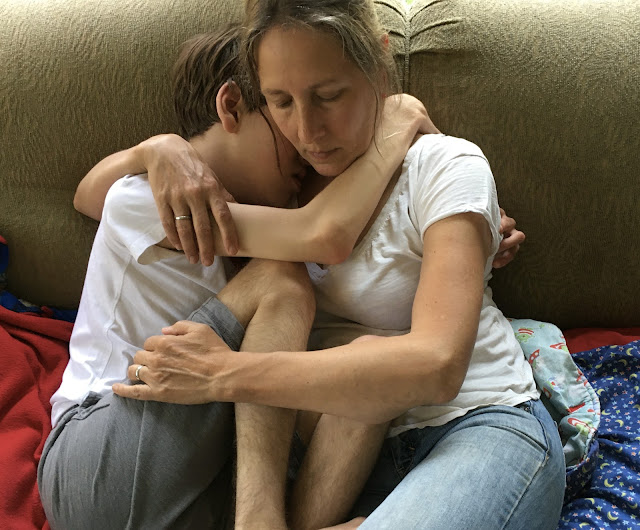
Photo by Michael Kolster

9.16.2020

"i am" poems

On Saturday, I received a second letter from my new pen pal who has been on death row in an Alabama "correction facility" for ten years. He's there along with about 165 other men who have also received death sentences, each languishing in their own little cell. Studies show that as many as four percent of death row inmates are likely innocent of the crimes they've been convicted of committing. That's equal to nearly seven innocents in that one Alabama prison alone, in a nation where some people cling to the platitude, All lives matter.

In response to my pen pal's letter, I told him I had recently finished the book, Reading with Patrick. It's author, Michelle Kuo, writes deftly and movingly about her time as a high school teacher in a small Mississippi Delta town. I went on to tell my pen pal that the author asked her students to write "I am" poems. I wrote a quick one in my letter to him:

I am strong
I wonder how life would have been if my son were "normal"
I hear my son complain, and I don't know why
I see the wind blowing through the trees
I want to make the world a better place
I feel sad some of the time
I cry when I am overtired and lamenting the loss of my child who is still alive
I understand how important it is to listen to others
I dream of a just and loving america and world
I try my best, but I still fail
I hope life gets easier, though I am still grateful for may things

I asked my pen pal if he might want to write an "I am" poem and send it back to me. I am hoping so.

At the end of my letter to him I drew a picture of our dog, Smellie, then signed off by saying, Know that I am thinking of you. I folded the pages around a self-addressed stamped envelope plus a family photo taken seven years ago which I discovered, slightly crumpled, in the back of my desk drawer.

I can't help but wonder what my son Calvin, who is nonverbal, cognitively and physically disabled, might write in his own "I am" poem if he were able. But since he isn't, I wrote a version for him, imagining him capable of certain complex thoughts:

I am a fighter
I wonder why I'm not going to school anymore
I hear my mom drop the F-bomb a lot
I see my mom get annoyed with me sometimes
I want to be able to do things by myself
I feel frustrated when I'm not understood
I cry when my head and tummy hurt
I understand that I am loved
I dream of being able to speak
I try to do my best at everything
I hope one day my seizures stop

Rereading my poems, I'm reminded of how vital it is to see life from another person's perspective, which is the main reason I was interested in raising a child. I want to understand why and how other people grieve. I want to bear witness to other's struggles and to feel empathy. It seems that the America we live in—one which too often embraces the myth of rugged individualism and mantras like, Don't tread on me—suffers from a lack of understanding and empathy for those who face certain stresses and obstacles in their daily lives which hinder their ability to live life fully, enjoy liberty and pursue happiness. I'm thinking of Americans who are homeless, hungry, hurting, cold. I'm thinking of Americans who are disabled, hated, disenfranchised, imprisoned. I'm thinking of Americans who don't have jobs, health insurance, savings, and those who can't vote.

I slide my folded letter and family photo into an envelope, address it, seal it, stamp it and pop it into the mailbox for its trip to Alabama. Doing so, I imagine my pen pal passing long hours in his cell. I consider the fact that he never got the chance to vote and will likely never be able to vote for the leaders who will write laws and policy which directly affect him. I think of the number of innocent people who are imprisoned and on death row who are disproportionately people of color. I wonder what kinds of "I am" poems they'd be writing if they could.

Photo by Michael Kolster

8.16.2020

unforgiving

It had been only three days since my son's last grand mal seizure. As Calvin convulsed, at first tangled in his covers, Michael and I caressed his arms and legs, kissed his face and told him that we love him. It was the first time in awhile that I cried after one of his seizures. Perhaps my tears were triggered by a state of physical and emotional exhaustion from months of taking care of a child who can do absolutely nothing by himself save play with his baby toys in a bed with side panels and a netted canopy. This pandemic has made everything about life harder. On top of that, Calvin's epilepsy has been unforgiving as ever.

When the seizure was over, Michael went downstairs to finish preparing dinner. I sat on a step stool next to Calvin's bed and kept vigil, watching and feeling my boy's chest rise and fall. In the dim room, as I mourned my son's condition, I wondered again how I'd keep it up, this caring for him as he grows into a young man. I don't really know the answer. In the quiet, I recalled how, earlier that day, I had seen little kids riding bikes with their friends, siblings and parents. Last week I'd seen a child half Calvin's age swimming in the brackish water off of Simpson's Point with his mother, the two of them chasing schools of hungry fish churning the water. I'd seen a little girl skipping down the street with her dog. I'd seen a young family buzzing around in a small community garden, perhaps picking raspberries, beans or tomatoes. My child has nothing to do with any of it. His body grows but most everything else about him stays the same. Though sixteen, he's still an infant-toddler. He still wears diapers, which in the hot, humid weather make him sweat. His go-to toys are still rattles and chewies. He still seizes. About the only things that are different are the soft, thin mustache that has appeared and is gradually darkening, and the thought that he is becoming permanently psychotic due to years of seizures and antiepileptic drugs.

As evening fell and the room around me darkened, my thoughts turned to the young man I just started writing to who is living the rest of his life on death row. Online, I've seen photos of the cramped, rusty, neglected cells in his so-called correctional facility. I wonder if he can ever see trees, stars, the moon, or hear wild things bark at night like I do. I wonder what he dreams about while I dream of things like my mom and dad, San Francisco, missing flights, breathing underwater, Calvin seizing. I wonder if this captive soul can remember what the world looks like outside the massive prison walls. Does he ever catch the scent of sweet clover? Hear the buzz of bees and the chirps of birds? Does he remember or see bodies of water slip under low bridges? Does he imagine gleeful children so unlike my son leap from their spans on these unforgiving days of summer?

8.07.2020

one of those days

Yesterday would have been one of those days when I'd cry on Woody's shoulder and he'd brush my tears away. It was also the first day in weeks that I walked down the street with Calvin to Woody's house. Knowing no one would be home, I let Calvin climb the steps to the side porch and, like so many times before, we tried to ring the doorbell. As I peered in through Woody's kitchen window, I felt sad knowing I'd never see him again, and I wondered what the new owners will think of a frustrated mother and her impossible son coming to bang and drool on the corner of their garage.

While I stood with Calvin as he mouthed the white vinyl siding, I noticed the small azalea I had planted for Woody a few years ago, the one which I insisted was pink and he swore was red. I saw that the hostas in the corner of his garden are beginning to bloom. I noticed how quiet it was standing in the driveway in the heat of midday, a stark difference from the morning I'd spent with a boy whose moaning, screeching and hollering has chapped my nerves to the point of fraying.

Back at home, as I sat on the green couch with Calvin batting away his flailing arms, cinching up my shoulders to keep from having my hair torn out, squinting my eyes and turning my head to avoid an errant fist, I began to weep. Every once in awhile I consent to feeling sorry for myself. Yesterday was one of those days.

After five months of consecutive daytimes taking care of Calvin by myself, I'm tired. I'm bored walking in circles behind my kid. I'm frustrated with his miserable antics. I miss seeing Woody. I'm mad at the world. At times, I resent my situation. I'm ready for life to get back to normal, whatever that means. I'm sick of the tiny little petty man in the Oval Office, despise his harmful and reckless policies, his deceit, his profiteering, his swamp full of bootlickers and cronies, his dog-whistle politics and the way he divides America. I'm demoralized by my son's relentless seizures, terrible behavior and my powerlessness to do anything to improve them.

Later in the day, while Michael was upstairs with Calvin, I watched as long shadows stretched across the backyard, heard crickets and birds chirping, noticed the sweetness of the tall phlox coming into bloom. A warm breeze swept across my face and carried a greying fringe of hair. I thought about the late afternoons when I'd go visit Woody, just as the sun bent around his front porch before falling off into the trees. We'd be sipping our toddies and watching the world go by, and maybe he'd be wiping away my tears.

7.26.2020

emotional landscape

There are days that are so dark that I wish my son would disappear into the ether, dissolve like a lozenge on my tongue, seep into the earth like so many drops of rain. And yet, I am without a doubt a better person having carried and cared for him all these years, and for that I owe him a debt of gratitude. But sometimes I wonder how long I can keep up with the intensity of care he requires, and I can't imagine others loving him, cuddling him, and responding to him—especially as he grows—in the way he needs to be happy, healthy and to thrive.

Thursday was one of those days—hard on my body, my psyche, my spirit. I got frustrated. I lost my patience. I screamed, once, long and hard and primal. I grieved. I felt a valley of contempt for Calvin as he screeched and writhed and moaned and flailed all day long and into the night in what we finally concluded was probably a ghost of benzodiazepine withdrawal. It's days like these that sink me, if only momentarily, into oceans of blues.

Among others, Calvin is at the root of my dark feelings. Pain and anger. Loss and grief. Frustration, hurt, impatience. Resentment and contempt. Since his birth, I experience these more deeply than ever before. But I embrace and honor them—these most human emotions we are sometimes taught to betray, suppress, abandon—while trying not to wallow. Perhaps they've gained gravity from the chronic grief of losing a child who is still alive: the loss of a boy who, if things hadn't gone wrong, right now would be riding bikes and running around town with friends; the loss of a boy who right now might be writing down his thoughts, might be studying the stars, protesting injustice; the loss of a boy who, in a couple of years, would perhaps be going off to college or exploring parts of the world like his parents had done.

But I am grateful for how this grief over my child informs my world, my thoughts, feelings and notions. Maybe, like befriending and falling in love with people here and abroad— folks of different backgrounds, religions, races, abilities and nations than my own—being Calvin's mother has helped me to better imagine, understand and consider what life might be like for others who struggle with hardship.

Maybe, by being Calvin's mother—getting injured by him, seeing him repeatedly seize, hearing him screech and holler, feeling so helplessly unaware of the source of his misery, watching him barely develop, worrying about his and our future, losing sleep, even having contempt for him—has taught me how to better forgive people who hurt, offend, betray, bully, wrong and deceive. I wager everyone has shit going on in their lives that hinders their ability to cope and to at times really see themselves, their words and actions, and to appreciate that of those around them, even ones they love.

Of course, there are the sunny emotions like joy and love, which live in concert with the virtues of selflessness, empathy, compassion, patience, humility, grace, charity, gratitude, apology and forgiveness. Calvin's purity and innocence inspire me to practice these, at least when I'm not in the thralls of a pity party or having my hair torn out. If only I were as gifted as he at delivering them so unconditionally. Regrettably, I fail, perhaps particularly in the patience department, though I wager my husband would disagree.

And so, upon reflection, it seems the richest, most interesting emotional landscape may not be the most clear, placid and brilliant, but one that has depth and shadows. Maybe it's one of despair juxtaposed with hope, of contentment alongside struggle, of joy straddling sorrow, each one complimenting the other, each one begging to be explored. Maybe the most meaningful days are when a troubled, agitated, impossible boy can melt into my arms, grinning and giggling at my kisses, and wherein we both discover sublime calm, if only for a moment.

7.10.2020

dear confederate

Dear Confederate, Neighbor,

You might wonder why I'm writing, Bear with me. I'll try my best to explain.


In the span of ten days my son Calvin has had nine seizures. He has endured thousands of these attacks since before the age of two. He's now sixteen. Constant assault comes not only from the seizures but from the drugs meant to suppress them. The root of his epilepsy, a brain anomaly, also renders him speechless. He still wears diapers, and can't walk without some assistance, especially near traffic or on rough terrain. He is legally blind, negotiating the world much like someone who can't see a few feet in front of their face. He can't really use a spoon and must have his food doled out in small pieces or he's liable to choke. He can't bathe or dress himself, or adequately express himself. He enjoys no independence. Days are endless, both of us largely confined by his condition.


I often wonder how long a brain and body can withstand such pummeling. Do the seizures torture his organs, his muscles, his joints, his bones? No doubt they make him struggle to breathe; I see it every time he seizes. How must he feel when his heart pounds so feverishly? Is he fearful when the seizures take aim? I gravely dread a future captive in this agony.


Dear Confederate,


On a recent escape, I took Calvin on our usual car ride—Pleasant Hill Road, Flying Point, Bunganuc, Woodside, Maquoit—except this time we drove the opposite way. At one point, on a hillside clearing next to a modest house, I spotted a strange and unsettling sight: a confederate flag. It was hoisted on a pole so tall as to belie any humble claim of it's intent. I wonder if you put it there to provoke.


As if doubting my eyes, I turned around in a gravel lot near the bay where at low tide folks break their backs digging for clams in the muck. Driving by for a second look, I craned my neck catching sight of your flag in my blind spot. In the absence of a mailbox, I tried to guess your address. I meant to send you a postcard or letter relating my dismay of the emblem which reveres traitors who defended a sinful and hideous institution. I want to describe its hurtful symbolism honoring those who fought to preserve the purchase, sale, exploitation and enslavement of human beings for profit.


Dear Confederate,

Do you know the enslavers' victims—innocent African men, women, and children—were kidnapped, stripped, shackled, and crammed into the bowels of ships like animals, with no room to move, little foul air, water or food to intake, steeping in each other's urine, vomit and feces for weeks? Do you understand entire families were torn apart? Infants and toddlers, tweens and teens were ripped from their mothers' embrace. Husbands and fathers, mothers, sisters and brothers were sold downriver. Children and adults were forced into grueling labor sunrise to sunset. The enslaved were terrorized, tortured, beaten, whipped, raped and lynched for the smallest infraction, if any. Do you know that these innocents endured this hell at the hands of White people for 400 years only to be set free without a penny for their labor? And it didn't end there; slavery's legacy morphed into other forms of atrocities and oppression such as massacres, lynchings, Jim Crow laws, segregation, bombings, disenfranchisement, redlining, the war on drugs, police violence, and today's mass incarceration. Did you consider that these injustices indelibly scarred, marginalized and financially crippled generations of virtuous, hard-working Americans? Are you unaware? Led astray? In denial? Fine with it?


Dear Confederate,


Again, I think about my son, Calvin, one of the sweetest beings you'd ever meet. I want to tell you, Confederate, how difficult life is for him. I want to chronicle for you the eternal beating on Calvin's brain and body, his suffering, his aches and pains, his constraints. I want to describe the relentlessness of it all, my son's regrettable inability to understand why this should be happening to him, why he is seizing and hurting and can't speak—this dutiful boy of mine, this pure and innocent soul who is deserving of none of this torture. I want you, Confederate, to understand how woeful it is to know that my son can't escape his tormenter, and that no matter what I do, I can't liberate him from his misery. I want you to imagine, know and feel my son's pain. I want you to witness our wretched situation. 


More so, Confederate, I want you to imagine yourself and your family shackled and enslaved—for that particular fate was infinitely worse than any suffering my son or I will ever have to face. I want you to understand what the rebel flag might mean to Americans who are descendants of the enslaved who live in its miserable wake, and for we who bear witness to the injustices they still face. 


Dear Confederate, let fall your flag and surrender 
for the sake of all America.


Calvin resting and eye-pressing after a spate of seizures.

5.19.2020

still sheltering

After a couple of months sheltering in place, and despite a rising coronavirus death toll, states are beginning to open again. Folks are lining up to get into their local barber, salon and drive-in. I heard that the ice cream stand up the road a spell was packed last weekend. I'm beginning to see groups of kids riding bikes together. Glorious weather is drawing neighbors outdoors. And while I miss our friends terribly, and long to gather with them, I'm still skittish.

Some folks are comfortable hanging outside in small clusters, their chairs spaced at what is thought a safe distance. Others are bringing childcare workers back into the fold. Many have continued to visit their extended family members—parents, grandparents, sons, daughters, in-laws. Some families have been "quarantining together" with other families all along—albeit not under one roof—citing their trust in one another despite evidence that wider circles exponentially increase the risk of getting the virus and spreading it to others.

Sunday, when I visited my friend outside for the first time since autumn, I kept my distance. He sat on one end of his ample porch, I on the other. When he sneezed, I pulled the collar of my jacket over my nose, envisioning the droplets hitching a ride on the wind. For months he's been receiving visitors on a daily basis, some of them frontline healthcare workers, others employed in various essential businesses potentially exposing them, and him, to the virus. So visiting him makes me a tad nervous.

As I watch the news unfold, I wonder how many of the brazen gun-toters protesting government shutdowns know that perhaps as many as half of infected people experience no symptoms while actively shedding the virus. Have they heard that small droplets can hang out in the air eight minutes, perhaps longer? Do they understand that wearing a mask is meant to protect others? When I explain to people why I am keeping such a distance, I wonder if they think I'm too zealous. Do they get how vulnerable Calvin is, or what a clusterfuck we'd be in if Michael or I were to get seriously ill? I mean, who would take care of Calvin if we were laid up, or worse? These questions lead my thoughts to little Charlotte Figi, a girl a lot like Calvin who died last month from complications of what was undoubtably Covid-19.

I feel there is so much we still don't know about this thing. We don't have a vaccine. We don't have a decent treatment. Immunity may be elusive; five sailors who fully recovered from it have recently become reinfected. And so, even though I'm eager to visit friends and host gatherings of our lovelies, for now I'll keep sheltering in. I'll continue to spend my days taking lots of short walks around the neighborhood and long car rides near the water with Calvin. I'll keep spending my mornings savoring time to myself in the woods walking Smellie and in the garden soaking up the beauty of flowers, hummingbirds and bumblebees, and dreaming. I'll keep looking forward to evenings with my husband who, thankfully and for a multitude of reasons, is the best person with whom I could ever find myself in quarantine.

Simpson's Point

5.09.2020

struggles

The snow hadn't yet begun to fall when I heard my son cry out at nine last night. I only half expected the seizure's arrival, this one in the wake of the full moon and a decent eleven days since his last grand mal. As usual, I crawled in bed next to him to make sure he kept breathing—the twenty minutes or so after a grand mal being the most risky to succumb to SUDEP (Sudden Unexpected Death in Epilepsy.) Just as I was falling asleep, Calvin clocked me in the face with his fist while he was shifting. I decided it was a good time to go sleep in the bed with Michael. Sadly, the extra THCA oil I'd given Calvin after the first seizure did not thwart the arrival of a second grand mal at 4:45 a.m. Perhaps it would have worked if I'd waited until midnight to administer it, but I was so goddamn tired I just couldn't.

By six the snow was coming down in gnat-like flakes, some of them floating upwards and crosswise as they neared the window. Like most everything in these coronavirus days, snow in May, even in Maine, is strange. Watching it come down, head on my pillow, I imagined it as some magical dust, some cooling off of the white-hot suffering, despair, frustration and anger many people are feeling during these essential shutdowns.

Slowly, I rose to see the garden, worrying that the young peony shoots might have been burned by the night's frost. Since yesterday, many blossoms have opened on the pink and purple small-leafed rhododendrons, a white one having already beat them to it. The garden is gradually coming into it's glory, even as deciduous trees are still mostly naked, save some tiny leaf buds emerging.

As if winter, today has been spent indoors trying my best to help my suffering kid feel better. He's not back to baseline, is more restless than usual, has clammy hands, stinky breath, foamy drool and no appetite to speak of. I'm tired and achy, and the sore throat I developed the other day is only slightly better. Still, looking out over the garden, the snow having finally given up without sticking, I'm feeling grateful. I have a house chock-full of windows, a gorgeous garden to devour and in which to wander, a sweet and loving husband who does all of the cooking, friends who leave delicious care packages on our porch, good books and films to lose myself in, and the privilege of not being a frontline healthcare or other essential worker during this pandemic.

But despite all there is to be grateful for, I'm still nervous about what is going on in this country, and ashamed of some Americans' behavior. It vexes me to hear that grocery store employees are being harassed by customers who do not want to follow state guidelines for wearing masks in public. I'm incensed at the ongoing lies, backpedaling, blame-shifting, cronyism and hypocrisy coming from the White House. I'm sickened by the news of hate crimes—so many still going unpunished—of innocent Black and Brown people who, amid their ongoing oppression, are disproportionately affected by this pandemic.

Outside, it's still below forty, though with winds at eighteen miles per hour it feels like the Arctic. But I'm sitting here at my desk with a view of the garden. Michael is home taking care of Calvin, who is doing slightly better and will be heading upstairs to bed fairly soon. I've just lit a fire in the wood stove and poured Michael and I a couple of early cocktails. Later, we'll warm up some ridiculously delicious chicken enchiladas with spicy salsa verde, and discuss the messed-up state of the nation. Then, we'll muse on gratitude, and I'll go to bed early and tired, though hopefully not pitying the situation with our own messed-up kid, but rather sympathetic for those out there in the world who are truly struggling.

4.07.2020

good run

It was a good run while it lasted, until this morning at four-thirty. Calvin went twenty days without a grand mal seizure, nearly three times his recent average and one of his longest seizure-free stints in the past few years. If he can make it until Friday without having any more, he'll have had only two grand mals in a month's time on the heels of March in which he had only three. My best guess is that the recent increases in my homemade THCA oil are what's helping. I'm giving him about three mgs THCA per kilogram of his weight. The only other drug he is taking for his seizures is Keppra, which is at his lowest dose in a decade.

What might also be enabling his seizure freedom is the fact that, beyond being bored, he is relatively stress-free staying home from school with Michael and I as his only caregivers. We spend a lot of time snuggling, hugging, kissing and tickling him all day long. What else is there to do? Weather permitting, we walk in the garden where he touches his favorite rhododendrons, the prickly mugo pine and several Alberta spruce. He takes leisurely baths, and we go on long car rides while I reach back and feed him grapes and blueberries from the driver's seat. During this coronavirus lockdown, he isn't taxed at all.

The past month or more we've seen Calvin smile a whole lot, like when Michael reads him his favorite book and even when walking down the sidewalk on our way to visit Woody. Sadly, because of the pandemic, we can no longer go inside and pilfer Woody's chocolate jar.

With any luck Calvin will have another good run with lots of smiles and giggles. Cross your fingers. Knock on wood.

3.01.2020

indifferent nature

I'm not one for praying, nor am I looking for answers as to why the world exists. I don't need evidence that there is life, intelligent or otherwise, on other planets. If I look to statistics and consider the magnitude of the universe, I already know the answer, which is yes. Though I lament life's miseries, I don't wonder why there is suffering in the world. Mankind can be cruel. Nature is indifferent. I only wonder, when reckless and despotic leaders war, oppress, starve and shell civilians, why others allow them to continue. But I guess I know the answer to that, too: power, money, conceit, control. I wonder why mutli-millionaires and billionaires aren't more charitable with the absurd profits they make on the backs of those who actually do the labor. Instead, they pocket those profits and too often pay starvation wages. These are the things I think about on days like this.

Last night at nine, Calvin had his third grand mal seizure in less than twenty-four hours. To stop the cluster I gave him Diastat—rectal Valium. It was the first time I had used it in months if not years. It has seemed to stop the seizures from advancing, but the real test will be whether he has more tonight. I don't know if Calvin is ill or if he is simply outgrowing his medication, or whether this worsening of clusters is an effect of eliminating his CBD oil recently. Like world torments, I don't question why my son suffers, at least not philosophically. As I said, nature is indifferent. But I would like to know the root of his weekly seizures, and I'll continue to search for ways to beat them into submission.

My thought this morning was to more seriously consider giving him the plant-based pharmaceutical CBD called Epidiolex. I've been following a Facebook page about the drug for months, noting its trends and side effects. It may be a last hope for Calvin considering he has failed ten anti-epileptic drugs. If we do decide to move forward with it, I'll likely put him on a fraction of the recommended starting dose. What I've noticed about CBD is that sometimes giving less is more effective and, like all drugs, too much can cause unwanted side effects including increased seizures.

Today my boy has been waking only for moments throughout the day, recovering from the assaults on his brain, and sleeping off the benzodiazepine. Though he is in a decent mood and seemingly content, I feel sorry for him. I've watched him seize thousands of times in his life. He sometimes turns gray-blue, bites his tongue and cheek till they bleed, may sometimes have vicious migraines and often appears woefully unsettled. Watching him suffer is punishing for me. Some folks believe that God punishes people who've sinned by doing things like "taking" their newborn babies, or rendering their children with afflictions, or causing natural disasters in liberal states, or allowing mass shootings in gay nightclubs. That is such bunk. The notion is so offensive, and I wonder how anyone could or would want to believe in a god that would behave that way.

Today, Calvin's buddy Mary came to watch him for a couple of hours in Michael's absence, so I was able to get outside with Smellie. The warmth of the sun offered respite amid a bitter thirty degrees. Some of the snow is melted and buds are beginning to swell on certain trees. I baked some chewy-crispy chocolate chip cookies for my friend who is now receiving Hospice care, though doing pretty well considering. In the garden, the greens of the Alberta spruce and the reds and purples of the small-leaf rhododendrons are gems right now. I wonder if we'll have an early spring. I'm hoping so. But you won't find me praying for it, because nature is indifferent. That's just the way She rolls.

12.25.2019

north star

Last night, while much of the world lit candles on their menorahs, celebrated the birth of the baby Jesus and prepared for the coming of Kwanzaa, I watched my son seize. He had fallen asleep about an hour prior, and just as Michael and I were readying for bed, I heard Calvin screech. When I got to him, he was reclined with all fours in the air, crooked, stiff, and trembling. There on his back, he couldn't breath. Quickly as I could, I unlatched his bed's safety netting and panel then, reaching in, yanked his right arm to turn him onto his side. Soon, oxygen began passing his lips again, which had turned a ghostly shade of grey-blue, his airway having been blocked by flesh or fluid.

Holding him close to me as he drifted back to sleep, I thought about the tens—perhaps hundreds—of thousands of others whose sons and daughters were also seizing, disrupting special gatherings and gift-giving, candle-lighting and festivities. I thought about refugees who had traveled miles, many to be separated from their parents, to be kept in cold cages, slumped on hard floors without their medications. I lamented the cruel way they've been forsaken.

Earlier, Michael and I had been moved to tears upon reading a message that one of Calvin's nurses, Rita, wrote to us in response to my recent post, hard conversations. Within her loving sentiments, she included this prescient quote:

"I want to know if you can get up, after the night of grief and despair, weary and bruised to the bone, and do what needs to be done to feed the children." —Oriah Mountain Dreamer

She went on to say:

I have the rare privilege of witnessing you and Michael do that day after exhausting day for years and years and years, perhaps for the rest of your lives.

You chose to share your beautiful, so severely limited son, a child who teaches us great lessons in compassion and loving more. In this gifting season, you all are one of the most profound gifts of my life.

Last night as I tucked him into bed, for the third or fourth time, he curled and cuddled into the covers, in his sweet peaceful way. As I kissed him goodnight, again, he gifted me with his sweet smile. He blesses me with his love. I am so grateful for Calvin.

I'm no believer in the folklore which teaches that Jesus is our savior and lord. But, because I have a child who inspires love, acceptance, compassion and empathy, I thought about Jesus, wishing others were so. And in pondering the stories of Christmas—the wise men, the refugees, the innkeepers—I realized Calvin is most like the North Star, bright and constant, shining on everyone no matter who they are.

Photographer unknown

12.04.2019

surrender to winter

Stepping ankle deep into freshly-fallen snow impedes my progress. But perhaps I need to slow down, take it all in, amid these thoughts of all-things-Calvin swirling around in my head like snowflakes in a squall. Dizzying, these ruminations on seizures, mania, drugs, and uncertain futures keep me up at night and nag me all day long.

Yesterday, however, was anything but a frenzy, trapped indoors with a mostly-happy and very huggy boy on this season's first snow day home from school. From just past dawn until nearly dinnertime, Calvin and I traipsed and flopped from sofa to table to bathroom shutters to bed and back again as the storm laid down its tiny white crystals, several inches in all. It was too wild, windy and frigid to brave the outdoors.

Today, though, everything is still. Clouds drift by nearly imperceptibly, beyond them peek patches of a soft blue backdrop. Bows laden with snow bob and sway with as little motion. As the sun works its way into the sky, blobs of snow drop from limbs and icicles drip diamonds which drill into the powder.

Winter is the time for dreams, when storms relegate us indoors, when the cold slows blood to molasses, when days are short and bedtimes early, when the low sun casts thin shadows over immaculate fields.

Where are we going? Who will we become? When will we be released? Will our days ahead by any easier? When and how might we succumb?

While at the fields, I ran into one of Michael's former photo students, Niles. He was taking pictures of snow and light, of colors faded in the mist of late morning. We embraced, talked of school and family, of his imminent travel to Paris and of speaking French. I urged him into the forest, where I'd seen sunlight eking through the tangle of branches. I had just emerged. He was headed there. Speaking to Niles about Calvin reminded me, thankfully, that these days are easier than olden ones.

It feels okay to surrender to winter. Here, there's really no escaping it. I remind myself to slow down. Step outside whenever possible. Muse on the falling flakes and the different paths they take. Contemplate the placement of shrubs, the whistle of a night train, the peachy feel of a loved one's cheek. Dream of last-minute trips to New York and of more seizure-free days. Embrace the chilly air, its crispness and ability to create starlit nights. Bask in the glow of a low sun casting shadows of living things otherwise gone unnoticed.

10.28.2019

dragon moms

We hear our children shriek and see them seize. We hold them in their suffering, dab lavender on their wrists and feet. We dread and loathe their cries and moans, regret their frequent misery.

We lug their gangly, growing bodies, change their dirty diapers, wipe and salve their seats. As if infants, we watch them in their slumber. We lay our palms against their chests to feel them breathe. We bathe and dry and dress their fragile, flailing frames. Lamentably, we feed them endless medicines. Readily, we stroke and kiss their cheeks.

We cut their food into bite-sized bits and dole it out piece by piece. We feed them by the spoonful though they're toddlers, tweens and teens. We wash their hair, wipe their chins, brush their teeth. We thwart their falls and hold their hands to keep them on their feet. They may be always in our keep.

These kids of ours have made us into Dragon Moms, in great part because they cannot speak. We become their voice, translate their sounds and moods and movements, foresee and understand their wants and needs. On their behalf we challenge, question, crusade, condemn, critique. Protect their vulnerability. Despite our candor, others still neglect our pleas. We are sometimes seen as monsters—feared, maligned, too often misconceived. No doubt to some we're nuisances, hysterics, freaks. We're merely fierce champions of our uncommon offspring. Come walk in our shoes. Please see our rocky path. Please feel our aching feet.

We Dragon Moms—though not our wish—a rare, formidable breed.

Photo by Michael Kolster

10.23.2019

on survival

On Saturday, I read an op-ed by a woman who had a third-trimester abortion. So many of the details she shared reminded me of my own pregnancy with Calvin—the fetal MRI, the countless ultrasounds, the wretched diagnosis, the empty spaces where brain matter was supposed to have formed but didn't. Just as the author experienced, a neurologist explained to me and Michael that Calvin would likely face developmental delays, might not crawl, walk or talk. What the doctor failed to mention, however, was that Calvin might be prone to having seizures.

I ruminated on the piece all weekend, even mentioning it to someone close to me. She asked me tenderly if, when I first knew of Calvin's brain abnormality, I ever considered having an abortion. She asked me, had I known of Calvin's troubles earlier in my pregnancy, if I would have had an abortion. She asked me, considering his seizures, insurmountable challenges and suffering, if I ever wished he hadn't survived. 

I did not consider having an abortion when I learned of Calvin's brain anomaly; my pregnancy was thirty-two weeks along. The thought never entered my mind, and no physician broached the topic. Had I known about Calvin's brain malformation earlier in my pregnancy, would I have had an abortion? I can't say for sure. Probably not. There were too many questions left unanswered for this optimist. As for my friend's third question about Calvin's survival, for weeks our boy struggled for his life. We were always pulling for him. He's here today. We love him. He's changed us in myriad ways. The kid has always been a fighter. Perhaps he teaches us about survival.

Having said that, in my very darkest most sleep-deprived hours, I do think about Calvin's mortality, sometimes even longing for deliverance for our child from his suffering, and from our strenuous, limiting, painful situation. I also worry about what will happen to him if he outlives us. Will people love and care for him? Will they keep him safe from harm? Will they be patient? Kind? Attentive? Tender? I think about how much easier life would be without having to take care of him—the constant vigil, the endless dirty diapers, the daily undertakings of a growing child who can do nothing without extraordinary help from others, the sleepless nights, the stress, the worry, the physical and emotional strain so taxing on my person. Then I imagine the enormous void he'd leave in my life, and I wonder, in that case, about my own survival.

10.06.2019

old self, new self

i want my old self back. the optimistic me instead of the worst-case-scenario one i'm sometimes told i've become. i want back the energetic, ambitious, hopeful soul. instead i feel puffy, tired, lost, sometimes melancholy.

i want my old self back, including hair which used to grow thick enough to lie on strong shoulders. i'll take back that hard body, too, the one which my friend robert once said felt like a dolphin, the one with the flat belly which i'd proudly take to the nude beach to go body surfing, the one that could run an eight minute mile with little problem and swim one-hundred yards in less than a minute.

i want my old self back, the one who could sleep in past six or seven, who was untethered, who didn't have a sick kid dictating nearly everything. I want my old self back, at least parts of her, like the part who didn't worry much, who looked at each day as a new opportunity, who dreamt of what life had in store.

but last night and today, i see parts of my new fifty-six-year-old self that i like: the friends i've made, the ones i've kept, the things i've learned about love, politics, race, justice and equality. i get to walk in a magical garden of my making while smelling the fire that's been made for me in our wood stove. i get to write long and hard and daily sometimes. i get to listen to the police and pink floyd and FIP. i get to drink gigondas and côtes du rhône and nibble on goat cheese that is out of this world. i get to gobble huge pieces of a friend's homemade carrot cake with crystalized ginger in its cream cheese frosting alit with silver sparkling candles that resist being blown out. tomorrow i get to celebrate nine years of writing this blog, which has been fulfilling beyond words. i get to look out every single window of this old house and see gorgeous fractals of green and bronze and red nearly every month of the year. i get to hang with my son and husband hugging and smooching. i get to make eggs and toast for my babies. i get to gather with my favorite homies drinking bourbon and wine and eating michael's ridiculously delicious food and laughing until i cry. i get to miss the ones who live out west and south and east. i get to drown myself in art and music and nature when time affords me.

so, on second thought, i guess i don't want my old self back. this one, though not necessarily more traveled mile-wise, is more worldly thanks to calvin and maine and age and the wicked smart people who surround me. and as i listen to pink floyd's sultry us and them, it seems to sway the pines outside my window at twilight, and beat with the pitter patter of calvin's footsteps in the upstairs bedroom with michael.

and so i'll take this new self, this self who still wears ratty jeans and adidas stan smiths, who has beloved in-laws and siblings who love and think of me and calvin and who, despite the clusterfuck that is my life, nevertheless resembles the old self and is still excited and hopeful for the future, whatever it holds.

Photo by Michael Kolster

9.20.2019

empathy and betterment

Though the grass is green, this dry spell has the shrubs curled up and thirsty. In their withering, I see myself, stressed and brittle. This journey as the mother of a child like Calvin—a teen who is legally blind, incontinent, nonverbal, physically and cognitively impaired, beaten by seizures and the drugs meant to thwart them—is a hard one both physically and emotionally. I'm chronically sleep deprived, burdened with worry, at times gripped by fear, anxiety and the shadow of devastation and despair. I wish I could somehow flee this reality. My mind is constantly buzzing with dour, unanswerable questions:

when will Calvin's next seizure be? will he choke on a piece of food? will he trip over a chair, run into a wall, fall down the stairs? do his bones ache from growing so fast? will he ever be able to tell us yes and no? will his various caregivers love him, keep him safe from harm? will he get good therapy at school? will he suffer another pain episode? will he ever be calm again? will he outgrow his seizures? will he die from one?

It appears that these burdens and worries most people don't fully understand. I see evidence in the scowls and puzzlement of strangers, in the way some folks avert their eyes when passing us, in the ways we have been dismissed or patronized by smug doctors, hospital nurses, and a handful of school employees over the years. I've little doubt that in my assertive, hypervigilant, helicopter mama-ness, I have haters and eye-rollers. There are those who don't take me seriously, think I'm oversensitive, inflexible, overbearing, unhinged. There are those who run when they see me coming, or who regularly assume the conspicuous and irksome cover-your-ass posture and pose. I wish all of them could walk in my shoes.

As is true with most of this nation's disenfranchised, misunderstood communities—the Disabled, People of Color, LGBTQI people, Muslims, asylum seekers, immigrants—Calvin and I are sometimes regarded with caution, mistrust and fearfulness, even perhaps contempt. I attribute this mistreatment to ignorance and a resulting empathy gap, an inability by some to more fully understand the struggles those on the margins of majority straight-White-Christian-able-bodied society endure, though all it really takes is openness and humility, to listen well and put oneself in other's shoes. But perhaps it's easier to avoid doing that, to stop short of admitting privilege, and less upsetting to avoid acknowledging ugly truths. But denial and indifference to the hardships of others gets us nowhere—as individuals, as communities, as a nation—on the path to betterment.

Wednesday morning, over coffee and a tasty blueberry scone at our favorite Dog Bar Jim cafe, a friend and I discussed the wave of asylum seekers from Angola and The Democratic Republic of the Congo whom our town has recently aided and absorbed. She recounted a conversation she'd had about the African soccer players who have joined the high school team, some who are quite good. Apparently, some parents are bemoaning the amount of playtime the asylum-seekers are getting (I can't help but wonder if their reaction would be different if the students were from Italy or England). When my friend's own soccer-playing son questioned it, she offered him an analogy: if he were to transfer to a new school with weaker players, he might get lots of playtime, too. A thoughtful kid, he understood.

My friend and I went on to discuss how helping asylum seekers is not the zero-sum game some purport is true. For example, we can also help our homeless neighbors and veterans, and we do. Furthermore, asylum seekers, once they're cleared to work, often fill the grueling, dangerous, tedious jobs many Americans don't want—harvesting crops, packing meat, caring for the elderly in nursing homes. My friend told me of a refugee physician who is driving a taxi just to make ends meet.

After our coffee date, I imagined the asylum seekers playing soccer with my friends' kids—one of a million things my son will never be able to do. Some of them speak four or five languages, having picked up Spanish and English on their journey north from Brazil. Many, if not most, traveled thousands of miles through South and Central America having escaped life-threatening circumstances back home. On their trek they survived beatings, muggings, hunger, thirst, and five months of travel on foot, at times through dense forests dark as night, stepping over the dead bodies of other refugees who would not make it to the USA. The ones who made it here are strong, tenacious survivors who likely have what it takes to make the best Americans. And yet, because of fearmongering and ignorance, they are sometimes met with animus and contempt, perhaps even envy and hatred. With this thought I imagine Calvin and the folks who seem to see him—without understanding his purity, love and struggle—as a freak, aversion or contagion.

I wonder what would happen if asylum seekers had the chance to tell their stories. Who would listen? Who would understand? Will these refugees, like Calvin, inspire some of us to become better people, better members of society? Will some of them give rise to other, better soccer players? Who, upon hearing their stories, would feel empathy and embrace them? And who would stand their ground, unmoved?

Carolyn Cole / Los Angeles Times

9.19.2019

spooning

This morning at three-forty-five I crawled in bed with our son Calvin for the umpteenth time in his fifteen years on this earth. He had suffered a tonic-clonic (grand mal), and when it was over I slipped into the small space between him and the back panel of his safety bed. There we spooned, my hand resting on his ribs feeling the rise and fall of his chest, his knees tucked up in fetal position. I stay awake as long as I can to ensure he doesn't stop breathing and die from SUDEP (sudden unexplained death in epilepsy). His risk of dying from SUDEP is greater than 1 in 1000 in any given year because of the nature of his seizures (uncontrolled tonic-clonic) and cognitive impairment.

Our first time spooning was when he was breech in utero, before I'd ever met him, before the dreadful sonogram revealing his brain's enlarged lateral ventricles and substantial lack of white matter, before the emergency cesarean, before the subsequent seven-week stay in the hospital. I'd rest my palm on my gravid belly on top of a bulge I was certain was his little head. Since then, when he sleeps with us, he loves to touch and press heads, and will pull us toward him, his hands around our necks.

When he was an infant and toddler, we'd regularly nap together. He'd curl up into me like a little bird in a nest. He used to be so calm, but since having to take antiepileptic medicines—particularly benzodiazepines—his body has a hard time quieting; he is so very restless. Still, at times, usually when he is sick, he settles enough to nap next to me or in my lap.

I've spooned with him in the hospital after ten-, twenty-, forty-five-minute seizures. I've spooned with him on the floor, on the couch, in his and our bed. Tiny for his age, he's getting bigger fast, but he still loves sitting in our laps for a spell, embracing us, clinging to us in bed.

2007

9.09.2019

regarding calvin

As my boy sleeps in my lap, in his bed, in our bed, on the couch, I hear the birds chirping outside. I feel the rumble of passing motorcycles and cars, see students strolling down the sidewalk. A week of school has come and gone, yet my boy remains sick at home. In my arms, we rest and pass the hours.

Yesterday, while on the couch together, Calvin looked right at me. This gift is rarely granted, and I found myself luxuriating in his pool-blue and yellow-flecked eyes. I did not take his gaze for granted; it's so rare that I see him look at me—almost never, it seems. But sometimes, when I put my face smack-dab in front of his, he does regard me. As a baby, if memory serves, he used to do it more often. I remember the day he got his glasses when he was a tiny eleven-month-old. It was like I could see the world flooding into his eyes—eyes which before had likely seen only shapes and colors.

Now, for whatever reason (autism, visual fields, seizures, drug side effects) Calvin usually disregards or looks at me peripherally. His eyes jerk and rove from his nystagmus. One eye often turns in, a phenomenon that, vexingly, his former ophthalmologist regularly denied, explaining it away as an optical illusion. No matter how confident I was of my son's eye-drifting or tugging-in (I'm the resident expert in observing Calvin closely) the doctor still rebuffed me.

Tomorrow, hopefully, Calvin will attend his first day of high school. He'll be greeted, fed, diapered, and escorted by a teacher and a staff who have rarely, if ever, worked closely with him. My anxiety is high, afraid he'll choke on food he doesn't chew well, fearful he'll fall off balance on the stairs or run into a door jam like he did this morning. Michael and I understand that Calvin, due to his poor vision (which glasses don't fully correct), his lack of coordination, and caregiver overconfidence or undervigilance, is a walking disaster, an accident waiting to happen. My hope is that the folks at school will regard him closely, will see what he sees and what he doesn't.

Calvin's first day with glasses when he was eleven months old.

9.05.2019

breathless

The sun, readying to set above smoky embers, kicks up a cool breeze. Gusts skip across the fields, flipping skirts like flags and ballooning blouses in a kaleidoscope of oranges, blues, reds and ochres. Ties fly sideways. Hats tumble off backwards. The diners, this year's college students, are dressed in their late-summer best—vibrant frocks and jumpers, slim sport jackets and slacks, suede loafers and strappy sandals. They arrive in clusters on the heels of convocation. Some run and hug each other. One squeals and jumps piggy-back onto another. Others stroll hand in hand, in pairs and trios. I feel their joy quite palpably, and it makes me smile ... and wither.

As I lead Nellie away from the flock, shielding my gaze from the sun's glare and from the unabashed gleam of hardy kids in their teens and twenties, I bow my head and cry. I weep lamenting my son Calvin's misfortune and his inability to one day experience such pomp and circumstance, such brotherhood and sisterhood, such revelry. I pity myself, too, lamenting my first few years of college which were so very different from this—the enormity of the university, the lack of good council, my disconnectedness, my disappointing swimming career, my disorientation in a sea of forty-thousand students, my lack of forming lasting deep connections.

I watch as these eighteen-hundred youths commune at rows of tables amid a sunny field, some of the best and brightest, these lithe and curvy, stout and muscly, black, brown, pale and white bodies speaking with various accents from around the nation and world. I want so much for things to be different. I want Calvin to suddenly speak and read and write and philosophize. I want him to look up into the night sky and wonder, want him to gaze across a sea, yearning for distant places to visit. I want him to hear and speak different languages, take risks, dream. Thinking of all these lost possibilities makes me breathless.

On our way home we walk against what seems like an endless stream of dapper students. Seeing them, I waffle between delight and despair. Out of the strolling throng pop two familiar faces, J.P. and Nate, two of Michael's former photography students. They each embrace me, smiling, before disappearing back into the crowd. For a moment I glow, knowing were it not for Michael's job as professor I'd never have met these worldly, kind and gifted souls. Then a young man walks past who reminds me of our friend-brother-son who took his life this time last year, and the one who lives nearby and yet has vanished, and I wonder where the others will go. And as I unleash Nellie to run the last few yards toward home—her understanding and ability seemingly far surpassing Calvin's—I remember his limitations and the ones which tether us to him so tightly, and my breath is whisked away once more.

Photo by Michael Kolster

8.27.2019

letting it out

My dear friend Elizabeth Aquino, whose adult daughter Sophie has epilepsy, writes the exquisite blog a moon worn as if it were a shell: where parenting, disability, politics and poetry intersect. In 2018, Elizabeth expanded her reach, becoming co-producer of a podcast called, Who Lives Like This?! The Grit and Grace of Caregiving, in which she and her co-host, Jason Lehmbeck, interview caregivers. It's a compelling venture in which Elizabeth and Jason ask thoughtful questions and offer their own insights on caregiving, which are often humorous and sometimes sorrowful and bleak. Last week she and Jason interviewed me about my experience raising Calvin and writing about it. They titled the podcast and corresponding blog, Letting it Out. I hope you'll tune in and share.